

SAP Extended Warehouse Management (SAP EWM) and digital transformation in the warehouse
Modern warehouse management and logistics processes in the SAP ecosystem
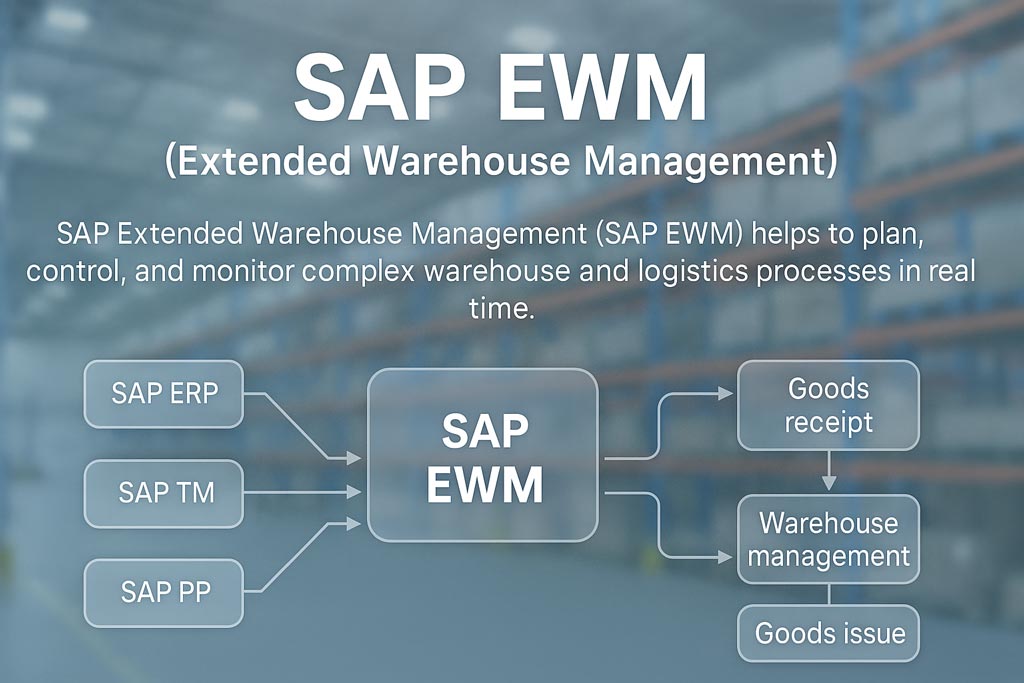
SAP Extended Warehouse Management (SAP EWM) enables companies to control complex warehouse and logistics processes in real time – in an integrated, transparent and scalable manner. The solution is the strategic successor to SAP WM (Warehouse Management) and is now the central component for modern, digital warehouse management in the SAP environment.
SAP EWM offers flexible options for mapping warehouse structures, material flows, picking and inventory management in a central platform. It is available both on-premise and in the cloud (embedded in S/4HANA or as a decentralised EWM instance).
What is SAP EWM?
SAP Extended Warehouse Management (EWM) is a modular warehouse management system that helps companies digitally plan, control, and monitor all warehouse processes – from goods receipt to dispatch.
EWM was developed as the successor to the classic SAP WM and offers extended functions for complex, highly automated warehouse environments. Unlike SAP WM, EWM not only covers simple warehouse movements, but also complex processes such as cross-docking, yard management, value-added services, material flow control (MFC) and resource management.
SAP EWM is fully integrated into SAP S/4HANA and can be operated there either as Embedded EWM (part of the S/4HANA system) or as Decentralised EWM (stand-alone instance with its own database).
The main tasks of SAP EWM
SAP EWM is designed to digitise and automate all operational warehouse activities.
Key tasks include:
- Goods receipt and goods issue: Control of physical goods movements, goods receipt inspection, storage, picking, packing and dispatch
- Warehouse control and optimisation: management of storage locations, shelves, high-bay warehouses and automated conveyor systems
- Inventory management: real-time monitoring of stocks, batches and serial numbers
- Order management: prioritisation, grouping and sequencing of warehouse orders
- Resource management: Control of workstations, equipment and employees in the warehouse
- Material flow control (MFC): Direct communication with automation systems such as conveyor technology, robotics or sorting systems
- Yard management: Management and control of vehicle movements and loading processes on factory premises
Embedded EWM vs. Decentralised EWM
A key distinguishing feature of SAP EWM is how the system is operated.
Both variants – embedded and decentralised – offer the same core functions, but differ in terms of architecture, performance and integration.
Embedded EWM (integrated in SAP S/4HANA)
- Embedded directly into the SAP S/4HANA environment
- Ideal for medium to large warehouses with a moderate degree of automation
- Shared database with ERP – no interface problems
- Lower infrastructure costs, faster implementation
- Direct access to ERP functions (e.g. purchasing, production, sales)
Decentralised EWM (stand-alone system)
- Separate installation with its own HANA database
- Suitable for very large, highly automated or international warehouse structures
- Better performance through decoupling from the ERP system
- Greater flexibility for updates, maintenance and system load
- Ideal for multiple ERP systems or globally distributed locations
In short:
Embedded EWM scores with simplicity and direct integration – decentralised with scalability and performance.
Functions and processes in SAP EWM
SAP EWM covers the entire warehouse process – from goods receipt to delivery.
The key functional areas include:
1. Goods receipt
- Creation and processing of inbound deliveries
- Goods receipt inspection, storage location allocation and warehousing
- Automatic warehouse orders and mobile data capture (RF)
2. Warehouse control
- Management of multi-level warehouse structures (warehouse areas, storage locations, resources)
- Use of strategies such as FIFO, LIFO, chaotic storage
- Dynamic replenishment control, cross-docking and slotting
3. Order picking and dispatch
- Control of pick & pack processes
- Multi-order picking, wave management and packaging units
- Integration with Transport Management (SAP TM) for shipping planning
4. Inventory management
- Real-time inventory monitoring down to the storage location level
- Integration with SAP MM (Material Management)
- Management of batches, serial numbers and handling units (HU)
5. Automation and MFS
- Direct connection to PLC systems and conveyor technology
- Visualisation of material flows and bottlenecks in real time
- Fully automatic order control in automated warehouses
6. Yard Management
- Management of deliveries, gate allocations and vehicle movements
- Transparent monitoring of waiting times and loading progress
Integration with SAP S/4HANA and other modules
SAP EWM is deeply integrated into the SAP ecosystem.
It works closely with modules such as SAP MM, SD, PP, QM and TM to enable end-to-end processes.
Examples:
- MM (Material Management): Integration for goods receipts and issues
- SD (Sales & Distribution): Coordination of order picking and dispatch
- PP (Production Planning): Supplying materials to production
- QM (Quality Management): Quality checks on incoming goods
- TM (Transportation Management): Transport and shipping control
In addition, EWM can be connected to SAP Digital Manufacturing (SAP DM) to seamlessly coordinate manufacturing and logistics processes.
Advantages of SAP EWM
The use of SAP EWM brings a number of strategic and operational advantages:
- Greater transparency: real-time overview of stock levels, orders and material flows
- Increased efficiency: automated processes and optimised resource utilisation
- Better scalability: Support for simple warehouses to global logistics networks
- Optimised costs: Less idle time, lower storage costs, higher turnover rate
- Improved quality: Complete traceability and fewer errors thanks to automation
- Integration: Unified platform for logistics, production and distribution
Migration from SAP WM to SAP EWM
As SAP WM will be replaced at the end of 2025, many companies are faced with the question of migration.
The transition typically takes place in several phases:
- Analysis of existing World Cup processes
- Definition of the target architecture (embedded or decentralised)
- Data migration and mapping
- Process optimisation based on SAP best practices
- Testing, training and go-live
Companies can use the intermediate step via SAP Stock Room Management – but with limited functionality.
In the long term, however, there is no way around EWM if modern, automated warehouse processes are to be implemented.
Fazit
SAP Recipe Development (SAP RD) is the central tool for companies that want to digitise and standardise their formulation and development processes. It combines product development, quality assurance and compliance into a continuous process – integrated into the SAP ecosystem and scalable for international organisations.
Whether in the food, chemical, pharmaceutical or cosmetics industries, SAP RD lays the foundation for faster innovation, higher quality and regulatory compliance throughout the entire product lifecycle.