
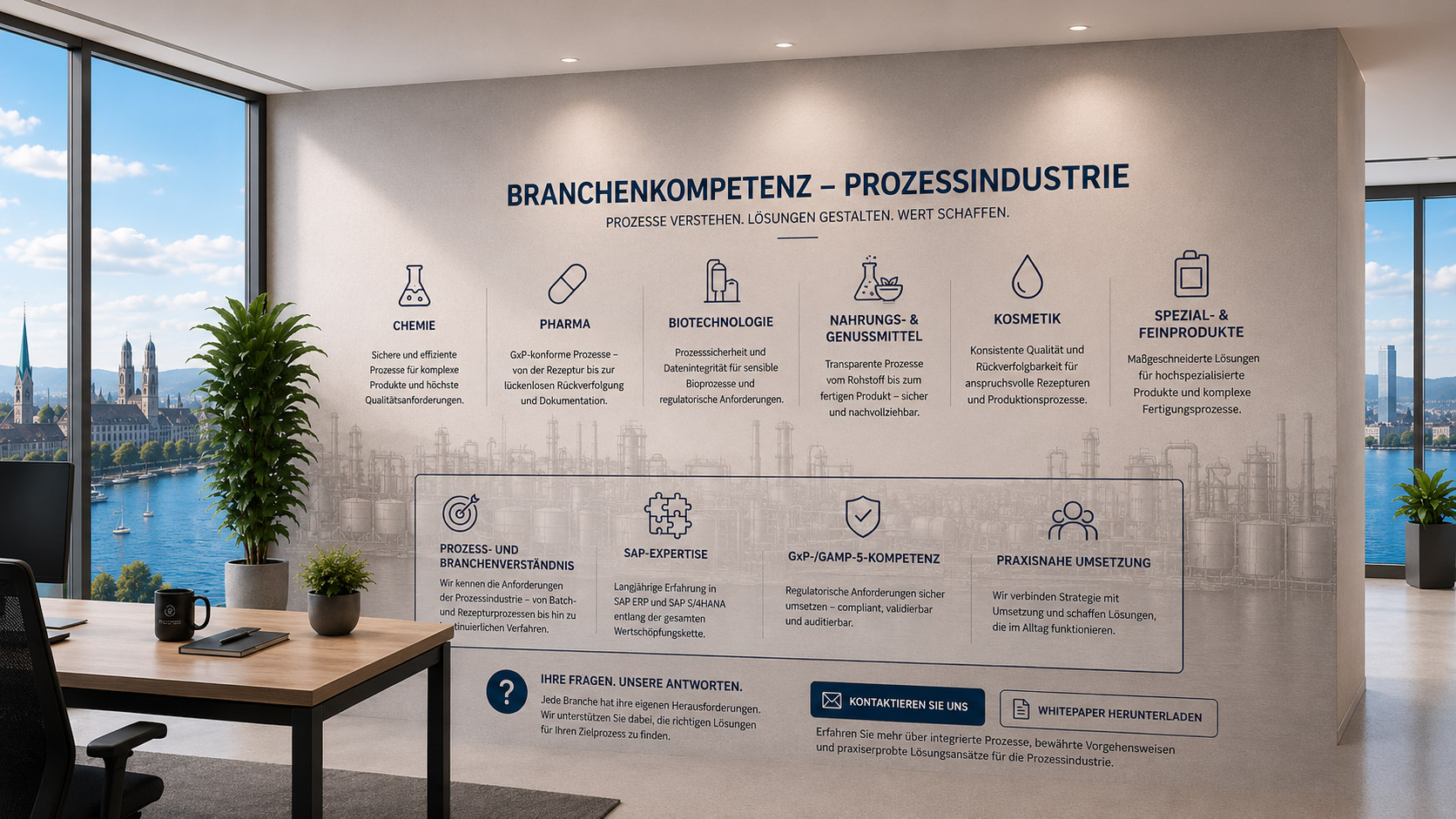
Industry expertise – Process industry
- Pharmaceutical industry: drug manufacturing, serialisation, batch tracking, GMP-compliant production
- Chemical industry: formulation development, hazardous substance management, environmental and safety requirements
- Food & Beverage Industry: Traceability, Shelf Life Management, Quality Assurance
- Cosmetics and perfume industry: formula management, declaration, regulatory compliance, sustainability
- Paint and coatings industry: mixing and dosing processes, quality testing, batch control
- Building materials and plastics industry: plant integration, process optimisation, energy efficiency
The process industry encompasses a wide range of sectors characterised by continuous or batch-based production processes. These include, in particular, the following: Chemical, pharmaceutical, food, beverage, cosmetics, oil and gas industries, as well as paints, varnishes, fertilisers, building materials and plastics. Despite their diversity, all areas have one thing in common: Complex formulations, strict regulatory requirements, high quality standards and continuous pressure to innovate.
In these industries, process stability, traceability and efficiency are key to success. Every change to a recipe, every raw material and every production step must be fully documented and analysed. At the same time, there is increasing pressure to produce more sustainably, use resources efficiently and shorten the time-to-market for new products.
Companies in the process industry face the challenge of finding a balance between flexibility and standardisation. Modern SAP solutions such as SAP S/4HANA, SAP PLM, SAP EHS, SAP Recipe Development (RD), SAP Batch Management, SAP ATTP and SAP Digital Manufacturing (DM) enable precisely that: they connect development, production, quality, logistics and compliance in an integrated system landscape.
Challenges facing the process industry
-
Regulatory complexity: Compliance with standards such as GMP, REACH, FDA, CLP or ISO.
-
Transparent traceability: from raw materials and recipe changes to the finished product.
-
Increased efficiency despite product diversity: high flexibility with consistent quality.
-
Safe and sustainable production: resource conservation, energy efficiency and CO₂ reduction.
-
Data integration: consolidation of laboratory, production, logistics and quality data in real time.
-
Pressure to innovate: Faster product development and market launches while minimising risk.
Digital transformation in the process industry
The future of the process industry lies in end-to-end digitalisation. The use of modern SAP technologies creates a networked, intelligent production landscape – from the initial idea and recipe development to the delivery of the finished product.
SAP S/4HANA dient dabei als zentrale Plattform, die alle Geschäftsprozesse integriert. Ergänzende Komponenten wie SAP PLM (für Produkt- und Rezepturmanagement), SAP EHS (für Umwelt, Gesundheit und Sicherheit), SAP DM (für Fertigungssteuerung) und SAP ATTP (für Serialisierung und Nachverfolgung) sorgen für durchgängige Transparenz.
SAP BTP (Business Technology Platform) provides the foundation for analysing process data in real time, implementing innovations quickly, and realising industry-specific enhancements using a low-code/no-code approach.