
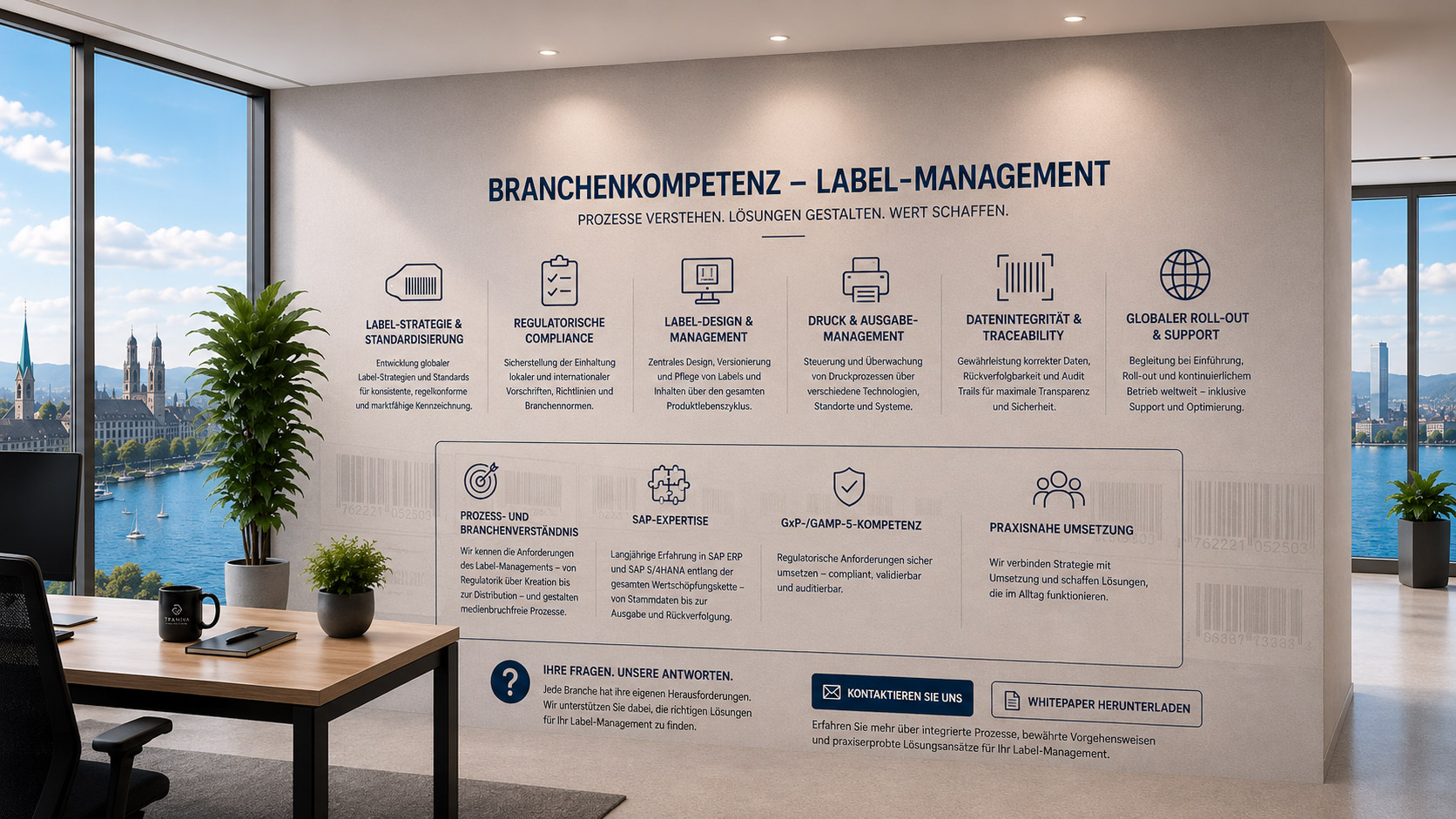
Industry expertise – Label Management
Label Management – Consistent labelling and traceability in the SAP environment
Label management plays a central role in modern manufacturing and logistics processes. It connects the physical world of products, containers and transport with the digital processes of ERP, production and quality systems. Efficient label management ensures that all products, components and materials are clearly identified, fully traceable and labelled in accordance with legal requirements at all times. In the SAP context, label management means much more than just printing labels: it is an integral part of the digital value chain – from materials management to production and shipping.
The aim is to automate, standardise and integrate all labelling processes in SAP in order to ensure a consistent database and a transparent supply chain.
💡 The diversity of our projects is not just a retrospective – it is the basis for the consulting approach Traniva uses today to guide medium-sized companies safely through the digital transformation.
Challenges in label management
Many companies face similar challenges when it comes to controlling and integrating labelling processes:
- Decentralised labelling systems and inconsistent printing processes in production, warehousing and shipping
- Lack of centralised versioning of label templates and layouts
- High manual effort for print approvals and label changes
- Safety and compliance requirements, e.g. GHS, REACH, FDA, EU CLP or CE marking
- Interface problems between SAP and third-party applications such as BarTender, NiceLabel or Loftware
These factors often lead to inconsistent labels, redundant processes and increased testing efforts – especially in regulated industries such as pharmaceuticals, chemicals, food or medical technology.
Integrated SAP solutions for label management
To overcome these challenges, many companies rely on SAP-integrated label management add-ons, such as it.LPI | LBMS (Label Printer Interface) or solutions from OPAL.
These solutions enable:
- Centralised management, versioning and approval of all label templates directly in SAP
- Automatic print triggering via defined events (e.g. goods receipt, production order, delivery note)
- Real-time data integration from SAP master data, batch management and quality management
- Connection to external label software such as BarTender, NiceLabel or Loftware
- Printer control and routing for different locations and lines
- Multilingualism and layout control according to product, region or customer
This makes label management a central component of the digital production landscape.
Benefits and added value
Label management that is fully integrated into SAP offers numerous advantages:
- Reduction of sources of error through automatic data transfer and process integration
- Shorter lead times in production and logistics
- High process and data quality through centralised control
- Regulatory compliance through traceable versioning and audit trails
- Cost efficiency through elimination of redundant label systems
Label management as an enabler of digital transformation
In the context of Industry 4.0, IoT and smart factories, label management forms the bridge between physical products and digital information flows. Labels become data containers that intelligently link production, quality and logistics processes.
In conjunction with mobile devices, scanners or RFID systems, this creates a fully networked, self-checking process chain – the basis for real-time transparency, compliance and automation.
Fazit
Label management is not an isolated side step, but a key strategic element of modern SAP system architectures. It combines efficiency, quality and compliance – and creates the conditions for integrated, audit-proof and globally standardised labelling across all processes and locations.