
GxP – Integrated processes – Weighing solution, MES & documentation?
In GxP-regulated processes, it is not enough to consider individual systems in isolation. What matters is how they interact: ERP, weighing, shop floor, MES or app solutions, documentation, approvals and traceability must all work together seamlessly.
The question is therefore not just which software is used, but above all:
Which solution is required at which stage of the process to ensure compliance, efficiency and quality in the long term?
This is exactly where Traniva comes in.
Which system manages the process?
Is the ERP system sufficient, or is a supplementary shop floor or MES layer required?
How is weighing carried out and documented in relation to the material?
How are material provision, weighing, batch tracking, tolerances and the audit trail accurately recorded?
Is an MES necessary, or is an app-based solution sufficient?
Not every company needs a fully-fledged MES straight away. In some cases, a targeted app solution for process instructions, feedback and checkpoints may be the more pragmatic approach.
How are the correct documents produced?
Which documents must be automatically generated, versioned and made available in a traceable manner before the process begins, whilst it is in progress, or after it has been completed?
How is GxP and GAMP 5 compliance ensured?
What validation scopes, data integrity requirements, roles, approvals and change control processes are required?
Traniva helps to answer these questions in a structured manner and to derive a viable solution architecture from them.
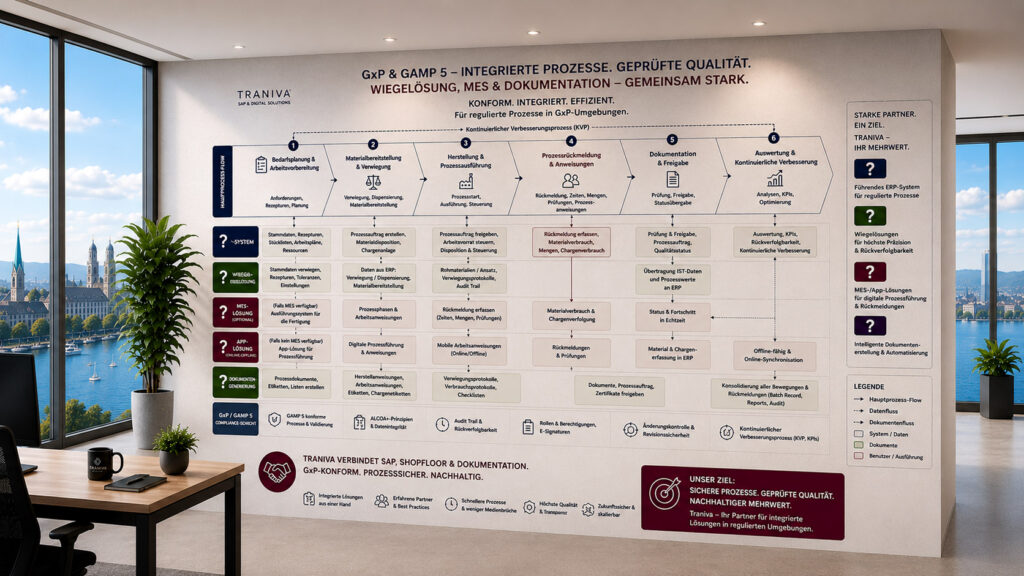
1. Requirements & Planning
Based on requirements, recipes, master data and process planning, the relevant materials, work steps and quality requirements are defined.
2. Material preparation & weighing
Materials are prepared, weighed and documented on a batch-by-batch basis. Tolerances, identification, audit trails and data integrity are particularly important in this process.
3. Production & Process Execution
The process order is executed. Depending on the target scenario, process control is managed via ERP, MES or a complementary app solution for digital work orders and process instructions.
4. Process feedback & instructions
Staff record times, quantities, checkpoints, material consumption and deviations. It is precisely at this stage that it is determined whether the process is merely documented or is actually managed digitally.
5. Documentation & Approval
Documents, minutes, reports, process order data, test records and approval information are generated, checked and made available in a traceable manner.
6. Analysis & continuous improvement
The data collected enables transparency, traceability, KPIs, deviation analyses and continuous improvement in the context of CAPA and process optimisation.
Particularly helpful for:
Process design
End-to-end processes, from the process order through to weighing, execution, feedback and documentation.
GAP Analysis
Assessment of existing processes, systems, data flows, media breaks and compliance requirements.
Solution Architecture
Definition of the roles played by ERP, weighing, MES/app solutions and document generation within the target process.
GxP and GAMP 5 considerations
Classification of the scope of validation, data integrity, audit trail, roles, approvals and change control.
SAP Integration
Reconciliation with master data, process orders, material movements, batches, confirmations and quality statuses.
Documentation Policy
A definition of which documents must be produced, when, from which data, and for what purpose.
A seamlessly integrated process achieves more than just digitalisation. It ensures reliability.
Greater transparency: All relevant process data is available in a structured format and can be traced.
Fewer media breaks: manual handover, Excel lists and duplicate data entry are reduced.
Greater process reliability: work instructions, feedback and approvals follow a clear process.
Improved auditability: data, decisions, changes and documents are traceable.
Scalability: The process can be expanded in stages – from a pragmatic starting point to a fully integrated solution.
Sustainable added value: Digitalisation not only supports compliance, but also efficiency, quality and continuous improvement.
Traniva supports companies in objectively assessing their skills and potential and using this to derive a clear strategic direction. Our goal is to combine the strengths of teams, processes and technologies in such a way that they deliver maximum benefit and productivity – today and in the future.