
SAP consulting for lasting success
- January 14, 2016
- Posted by: tranivainfo
- Categories:

SAP consulting for lasting success
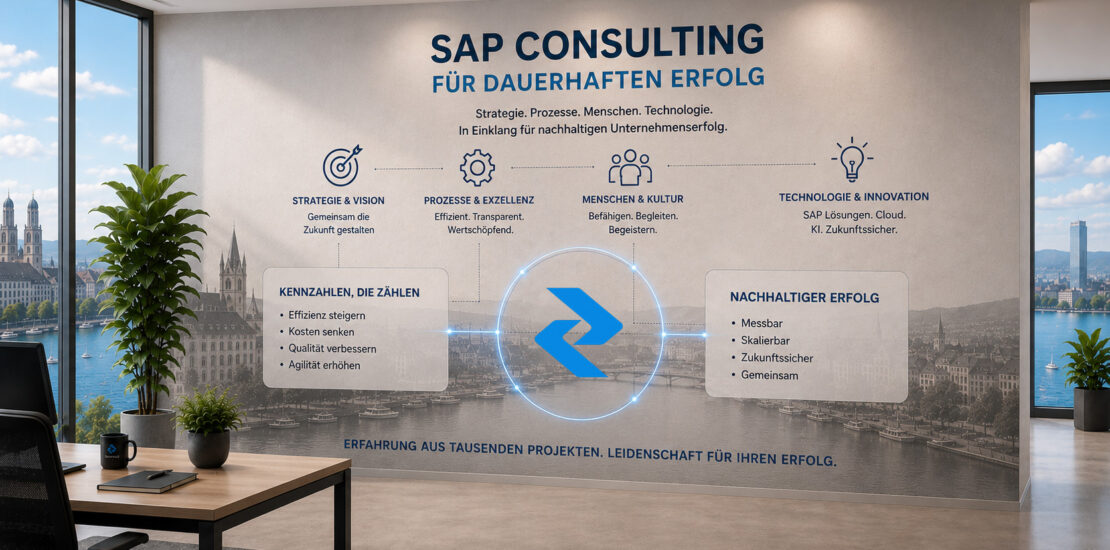
Efficient processes and reliable systems are the backbone of every company. Without a stable and future-oriented SAP landscape, no company can be successful in the long term. That is precisely why Traniva supports its customers in optimally aligning and sustainably developing their SAP systems.
We offer consulting services that strengthen your digital transformation, stabilise your system landscape and help you make the right decisions for your SAP strategy:
- Process analysis & optimisation – creating transparency and designing efficient processes
- Technology and system consulting – tailor-made recommendations for SAP S/4HANA, Fiori and cloud solutions
- Industry and market knowledge – tailor-made solutions for manufacturing, pharmaceuticals, food and other sectors
- Data & information management – structured preparation of relevant company data
- Project and transformation support – from planning to successful go-live
With Traniva, you can ensure sustainable success in the SAP environment – through expertise, experience and a clear vision of the future.
↑ Dynamic bar chart
Assumption (daily rate varies according to consultant role)
- Cost calculation: Average duration × €144,000/month (6 FTE × 20 working days × €1,200/working day).
- Project duration (0–10): standardised to a maximum of 36 months (e.g. 12M = 3.3; 24M = 6.7).
- Costs (0–10): standardised to max. 36 × €144k/month = e5.18 million (e.g. €1.73 million = 3.3).
- Degree of innovation, risk, flexibility, change effort: qualitative assessment based on SAP practice, consulting and migration projects.
Example evaluation matrix
| Approach | Project Duration (0–10) | Degree of Innovation (0–10) | Risk (0–10) | Flexibility (0–10) | Avg. Cost (€) | Cost (0–10) | Change Effort (0–10) | Why / Reason |
|---|---|---|---|---|---|---|---|---|
| Brownfield | 3.3 (≈ 12M) | 6 | 4 | 5 | approx. €1.73M | 3.3 | 5 | Fast & cost-efficient, low risk, but less flexibility & innovation. |
| Bluefield | 4.6 (≈ 16.5M) | 8 | 6 | 7 | approx. €2.38M | 4.6 | 6 | Good balance: more innovation than Brownfield, shorter & cheaper than Greenfield. |
| Greenfield | 6.7 (≈ 24M) | 10 | 7 | 8 | approx. €3.46M | 6.7 | 8 | Maximum innovation & flexibility, but expensive, time-consuming & riskier. |
Sustainable & Safety-Oriented
Compliance & Standards
Traniva works according to recognised SAP and project management standards (e.g. SAP Activate, ITIL, GxP) to ensure maximum quality and traceability.
Secure customer data
All customer data is processed and protected in accordance with the highest security standards – compliant with GDPR and Swiss DSG.
Separate system landscapes
Project and customer data are managed in clearly separated system environments. Test, development and production systems remain clearly separated from one another.
Risk management & stability
Through continuous monitoring and proven methods, we ensure that projects run smoothly and that risks are identified and mitigated at an early stage.
Transparency at every stage
Traniva stands for complete transparency: clear project plans, comprehensible decisions and open communication at all times.
Capacity and resource management
Project resources are planned in such a way that even large and complex SAP landscapes can be implemented reliably and within defined parameters.
Development index (0–40, standardised)
For success
SAP strategies
Development of sustainable roadmaps for brownfield, greenfield and bluefield sites.
Processes & Systems
Optimisation of core processes with S/4HANA, Fiori and cloud integration.
Compliance & Security
GDPR-compliant data processing and stable system architectures.
Innovation & Agility
Utilisation of modern technologies (AI, automation, analytics) for growth.
↔ Dynamic line graph
Stability/efficiency assessment matrix
- Analyse Stabilität (10): Am Projektstart gibt es noch wenig stabile Strukturen – bestehende Systeme sind oft ineffizient oder müssen komplett neu bewertet werden.
- Design stability (15): Initial structures are created, processes are modelled but not yet implemented.
- Build (implementation/customisation) Stability (20): The system is taking shape, customisation and initial developments are stabilising the architecture.
- Test stability (25): Stability reaches its peak through integration tests and end-to-end checks.
- Migration stability (27): Data migration strengthens the system basis, stability is very high.
- Stability training (25): Stability remains high as users are trained and processes are consolidated.
- Go-live stability (23): After go-live, the solution is fundamentally stable and processes are running in day-to-day business. The index value of 25 indicates a good, solid state, but not “maximum”, as further adjustments (e.g. performance tuning, support, change requests) are still necessary for stabilisation.
- Stabilisation Stability (25): Processes are running reliably again, the most important errors have been fixed.
Innovation level assessment matrix
- Analysis Innovation (25): New ideas and strategic considerations dominate. The degree of innovation is very high here because no technical limits have been set yet.
- Design Innovation (18): Innovation remains high as solutions are designed and creative approaches are explored.
- Build (implementation/customising) Innovation (16): The focus is less on innovation and more on implementation. New ideas are put on hold.
- Test Innovation (17): Innovation continues to decline as the focus shifts to troubleshooting.
- Migration Innovation (20): Innovation is picking up again slightly as new features are being considered for the live system.
- Training Innovation (25): Both values are equal – training brings both process clarity and ideas for improvement.
- Go-Live Innovation (30): After a successful go-live, the focus is often placed on additional innovations: new Fiori apps, analytics, automation or integration into the cloud. With a value of 35, innovation is particularly pronounced in this phase – because the foundation is now in place and new ideas can be implemented quickly.
- Stabilisation Innovation (35): Innovation is being strongly promoted on the basis of the stable platform (e.g. Fiori apps, cloud, automation).
