
TAOM™ Framework
The Growing Body of Knowledge of the Adaptive AI Organization Method™TAOM is not a one-time presentation or a completed methodology manual.
TAOM is published as a growing, version-controlled and traceable Body of Knowledge. Its purpose is to progressively support organizations, project teams, architects, Process Owners, leaders, employees and AI systems with a shared organizational language and a practically applicable method.
The publication follows the concept of established framework portals: the overall structure remains stable, while individual chapters, reference models, practical examples, tool mappings and implementation guides are added, reviewed and versioned step by step.
TAOM is developed by Traniva and continuously refined based on practical project experience, scientific perspectives and established industry standards.
One central guiding principle connects all components of the framework:
Organizations create value through people. Technology amplifies people. Artificial Intelligence augments people. Management enables people. TAOM connects them all.
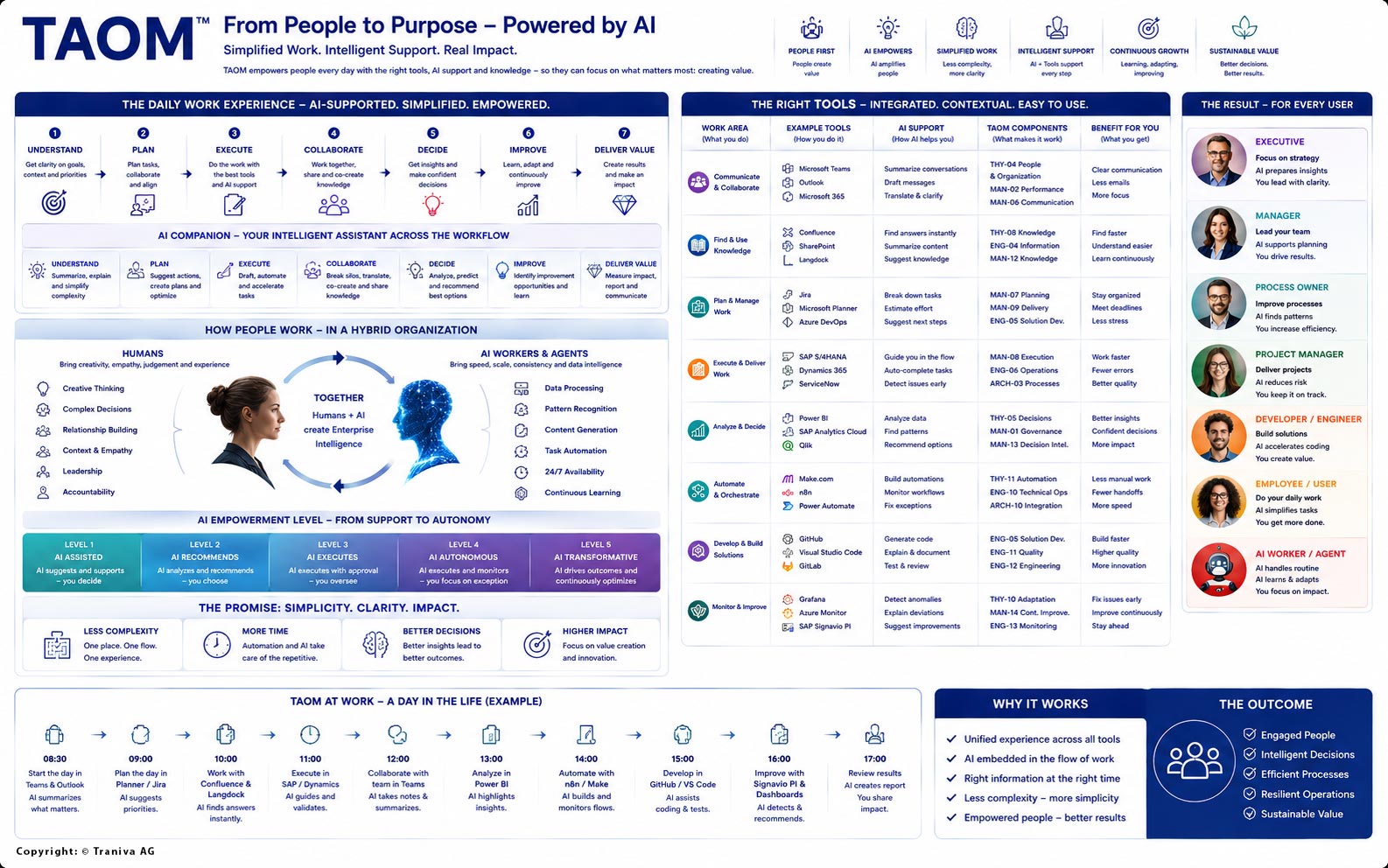
Canonical Chapter IDsEvery normative TAOM chapter has a unique and permanently applicable Chapter ID.
The Chapter IDs provide the common reference across the framework, website, graphics, process models, BPML repository, tool mapping, agents, requirements, controls, tests and implementation guides.
- THY denotes TAOM Theory.
- OS denotes TAOM Operating System.
- MGT denotes TAOM Enterprise Management.
- ARC denotes TAOM Enterprise Architecture.
- ENG denotes TAOM Enterprise Engineering.
- TOOL denotes TAOM Enterprise Tooling.
The IDs are not changed depending on individual graphics, tools or projects. All representations and mappings must refer to this canonical structure.
Framework Structure
Introduction and TAOM Constitution
The Introduction explains the motivation, objectives, language, scientific approach and positioning of TAOM.
The TAOM Constitution contains the binding foundational principles of the method, including:
- scientific orientation
- practical applicability
- Human-Centered Organization
- Human before Framework
- organizational reality
- integration of existing methods
- continuous adaptation
- AI-native Thinking
- Living Documentation
- ethical and responsible development
- human accountability and Human-in-the-Loop
- value creation through people, supported by management, technology and Artificial Intelligence
Part I — TAOM TheoryThe Theory describes the fundamental questions from which all other TAOM components are derived.
THY-01 — What is an Organization?
Defines organizations as adaptive socio-technical systems composed of people, knowledge, decisions, capabilities, technology and Artificial Intelligence.
THY-02 — What is Value?
Defines value, value creation, Stakeholder Value, Customer Value, Human Value, Organizational Value, Societal Value and Knowledge Value.
THY-03 — What is Work?
Defines work independently of positions and departments as purposeful execution performed by humans, machines and AI Workers.
THY-04 — What is Knowledge?
Defines knowledge as a core enterprise resource and the foundation of Enterprise Memory and organizational learning.
THY-05 — What is Intelligence?
Defines human, collective, organizational and artificial intelligence.
THY-06 — What is a Decision?
Defines decisions as the mechanism through which knowledge is transformed into actions and outcomes.
THY-07 — What is a Capability?
Defines capabilities as stable building blocks for strategy, value creation, organization and change.
THY-08 — What is Learning?
Defines human learning, organizational learning, Machine Learning and adaptive learning mechanisms.
THY-09 — What is Adaptation?
Defines adaptation, resilience, evolution, transformation and continuous improvement.
THY-10 — What is Governance?
Defines governance as the coordinated direction of decisions, behavior, authority, accountability and control.
THY-11 — What is Artificial Intelligence?
Defines Artificial Intelligence from an organizational and enterprise perspective.
THY-12 — What is an AI Worker?
Defines AI Workers as governed computational organizational actors operating within clear authority, knowledge and control boundaries.
THY-13 — What is an Adaptive Enterprise?
Integrates all theoretical foundations into one coherent theory of the adaptive organization.
Part II — TAOM Operating SystemThe Operating System describes the common mechanisms required by an adaptive organization.
OS-01 — Theory Translation
Translates the scientific foundations of TAOM into practically applicable enterprise mechanisms.
OS-02 — Enterprise Principles
Defines the universal organizational, human, technological and adaptive principles.
OS-03 — Enterprise Meta Model
Defines the canonical Meta Model with Enterprise Objects, Relationships, States, Events, Behaviors and Lifecycles.
OS-04 — Enterprise Language
Defines the shared language, terminology, taxonomy and semantics for people, systems and AI.
OS-05 — Enterprise Value System
Connects Purpose, Stakeholder Outcomes, priorities and measurable Value Realization.
OS-06 — Enterprise Intelligence System
Defines the cognitive mechanisms of the organization and the relationship between human and artificial intelligence.
OS-07 — Enterprise Knowledge System
Defines the creation, structuring, governance, use and continuous evolution of organizational knowledge.
OS-08 — Enterprise Decision System
Defines transparent, traceable and governed decision mechanisms.
OS-09 — Enterprise Capability System
Defines Capability Models, Ownership, Lifecycle, Portfolio, Governance and Maturity.
OS-10 — Enterprise Organization System
Defines organizational structures, roles, teams, communities, networks and collaboration.
OS-11 — Enterprise Execution System
Defines how strategy, decisions and capabilities are translated into processes, work and outcomes.
OS-12 — Enterprise Adaptation System
Defines continuous improvement, learning, transformation, innovation and resilience.
OS-13 — Enterprise AI Workforce System
Defines the integrated collaboration of people, AI Workers and AI Agents.
OS-14 — Enterprise Digital Twin System
Defines the living digital representation of the organization and its states.
OS-15 — Enterprise Governance System
Connects governance, risk, compliance, security, privacy, ethics and accountability.
OS-16 — Enterprise Architecture System
Defines architecture as the structural representation of the adaptive enterprise.
OS-17 — Enterprise Transformation System
Defines transformation as the governed evolution of capabilities, knowledge, governance and intelligence.
OS-18 — Enterprise Measurement System
Defines KPIs, metrics, organizational health, maturity and Value Measurement.
OS-19 — Enterprise Ecosystem System
Defines the organization’s relationships with partners, networks, platforms, markets and regulators.
OS-20 — Enterprise Feedback System
Defines how internal and external signals are transformed into learning, decisions and adaptation.
OS-21 — Enterprise Coordination System
Defines the coordination of people, AI Workers, teams, capabilities, decisions, resources and dependencies.
Part III — TAOM Enterprise ManagementEnterprise Management describes how the mechanisms of the Operating System are permanently governed and operated.
MGT-01 — Strategy Management
Defines Purpose, Vision, Mission, strategic objectives, priorities, strategy execution and strategic governance.
MGT-02 — Organization Management
Defines organizational design, roles, responsibilities, collaboration, development and organizational health.
MGT-03 — Capability Management
Defines the identification, assessment, ownership, investment, roadmaps and development of capabilities.
MGT-04 — Knowledge Management
Defines the capture, structuring, quality, governance, distribution and use of knowledge.
MGT-05 — Decision Management
Defines decision processes, Decision Rights, Decision Intelligence, quality, bias and escalation.
MGT-06 — Process Management
Defines Value Streams, processes, workflows, Process Governance, Process Mining, automation and improvement.
MGT-07 — Resource Management
Defines human, financial, physical, digital and AI-related resources and their capacities.
MGT-08 — AI Workforce Management
Defines collaboration, roles, competencies, governance and development of people, AI Workers and AI Agents.
MGT-09 — Governance Management
Defines policies, risks, controls, compliance, security, privacy, ethics and human accountability.
MGT-10 — Performance Management
Defines KPIs, dashboards, reviews, benchmarking, organizational health and the effects of measurement systems.
MGT-11 — Change and Transformation Management
Defines change, communication, Stakeholder Engagement, Adoption, Learning and Transformation Governance.
MGT-12 — Enterprise Delivery Management
Defines projects, programs, products, services and hybrid Delivery Models as well as the selection and combination of established methods.
Part IV — TAOM Enterprise ArchitectureEnterprise Architecture describes how the organization is structurally represented and made traceable.
ARC-01 — Enterprise Architecture
Defines Enterprise Architecture as the integrated structural model of the organization.
ARC-02 — Business Architecture
Defines Business Strategy, Capabilities, Functions, Services, Value Streams, processes and organizational structures.
ARC-03 — Capability Architecture
Defines Capability Maps, hierarchies, dependencies, ownership, heatmaps and roadmaps.
ARC-04 — Information Architecture
Defines Information Domains, Information Objects, ownership, quality, lifecycle and governance.
ARC-05 — Data Architecture
Defines Data Domains, Data Models, Master Data, Transactional Data, Metadata, quality and governance.
ARC-06 — Application Architecture
Defines the Application Portfolio, Application Landscape, ownership, lifecycle and rationalization.
ARC-07 — Integration Architecture
Defines APIs, Events, Messaging, Integration Patterns, synchronization and Integration Governance.
ARC-08 — Technology Architecture
Defines infrastructure, cloud, networks, platforms, containers, Edge Computing and technology lifecycles.
ARC-09 — AI Architecture
Defines AI Platforms, Foundation Models, AI Services, pipelines, integration, security and lifecycle.
ARC-10 — Security Architecture
Defines Identity, Access, Zero Trust, Cybersecurity, Information Security, Privacy and Security Governance.
ARC-11 — Digital Twin Architecture
Defines the Enterprise Twin, Capability Twin, Organization Twin, Knowledge Twin, Process Twin and Resource Twin.
ARC-12 — Solution Architecture
Defines solution-specific architectures, components, integration, quality, validation and documentation.
ARC-13 — Reference Architectures
Defines reusable Business, Capability, Information, Data, AI, Technology and Industry Architectures.
ARC-14 — Architecture Governance
Defines Architecture Boards, Reviews, Decisions, Principles, Standards, risks and compliance.
ARC-15 — Architecture Repository
Defines the repository for models, capabilities, processes, knowledge, references, versions and traceability.
Part V — TAOM Enterprise EngineeringEnterprise Engineering describes how organizations are analyzed, designed, implemented, tested and continuously improved.
ENG-01 — Enterprise Engineering
Defines Enterprise Engineering as the discipline for designing and continuously improving adaptive organizations.
ENG-02 — Enterprise Design
Defines Organization, Capability, Value, Service, Governance, AI-native and Human-centered Design.
ENG-03 — Enterprise Analysis
Defines Current State Analysis, Stakeholder Analysis, Capability Analysis, Process Analysis and Gap Analysis.
ENG-04 — Enterprise Planning
Defines strategic planning, Capability Planning, Transformation Planning, scenarios and roadmaps.
ENG-05 — Enterprise Portfolio Engineering
Defines investments, initiatives, project, product, capability and AI portfolios.
ENG-06 — Enterprise Roadmap Engineering
Defines coordinated transition paths between Current State, Transition States and Target State.
ENG-07 — Enterprise Transformation Engineering
Defines requirements, designs, dependencies, experiments, implementation, verification and learning.
ENG-08 — Enterprise Simulation
Defines process, resource, organizational, risk, AI and Digital Twin simulations.
ENG-09 — Enterprise Optimization Engineering
Defines optimization problems, hypotheses, constraints, experiments, implementation and outcome verification.
ENG-10 — Enterprise Innovation Engineering
Defines Opportunity Discovery, hypotheses, prototypes, scaling and integration of innovations.
ENG-11 — Resilience Engineering
Defines critical capabilities, Failure Modes, redundancy, recovery, crisis simulation and Resilience Testing.
ENG-12 — Sustainability Engineering
Defines economic, environmental and social sustainability as well as lifecycle and impact considerations.
ENG-13 — Enterprise Intelligence Engineering
Defines Knowledge Engineering, Decision Engineering, AI Engineering, Reasoning, Explainability and Trust Calibration.
ENG-14 — Enterprise Evolution Engineering
Defines long-term organizational evolution, signal detection, experiments, selection, scaling and learning.
ENG-15 — Enterprise Engineering Reference Models
Defines reusable Engineering Models, Patterns, Templates, Assessments and Best Practices.
Part VI — TAOM Enterprise ToolingEnterprise Tooling describes the digital capabilities, platforms and integrations required for the practical implementation of TAOM.
TAOM remains vendor independent.
Enterprise Tooling does not mandate specific products. It defines the required capabilities, responsibilities, data objects, integrations and governance rules.
Multiple products may support the same TAOM capability. What matters is not the number of tools used, but their controlled integration into one coherent Enterprise Operating System and Enterprise Digital Twin.
TOOL-01 — Enterprise Tooling Principles
Defines Vendor Independence, Capability-driven Tool Selection, Single Source of Truth, API-first Integration, AI Readiness, Semantic Consistency, Open Standards, Lifecycle Management and Tool Governance.
TOOL-02 — Human Digital Workplace
Defines the integrated digital workplace through which people and AI Workers create value together.
It includes Employee Experience, AI Workplace, Knowledge Access, Personal AI Assistants, Collaboration Platforms, Enterprise Search, Decision Support, Digital Workspaces, Human Productivity and Continuous Learning.
TOOL-03 — Enterprise Knowledge Platform
Supports Enterprise Memory, knowledge repositories, wikis, policies, standards, Lessons Learned, Best Practices, glossary, ontology and AI Knowledge Context.
Example platforms: Confluence, SharePoint, Langdock, Notion, Guru and Obsidian.
TOOL-04 — Enterprise Architecture Platform
Supports Capability Maps, Process Models, Value Streams, Organization Models, Information Models, Application Landscapes, Technology Landscapes and Traceability.
Example platforms: SAP Signavio, LeanIX, Ardoq, Bizzdesign, MEGA and Archi.
TOOL-05 — Enterprise Delivery Platform
Supports projects, programs, portfolios, Product Backlogs, Requirements, User Stories, Tasks, Releases, Tests and Change Requests.
Example platforms: Jira, Azure DevOps, GitHub Projects, SAP Cloud ALM and SAP Solution Manager.
TOOL-06 — Enterprise Execution Platform
Supports the operational execution of Finance, Procurement, Manufacturing, Logistics, Sales, Service, HR, CRM, ERP, MES, LIMS and PLM.
Example platforms: SAP S/4HANA, Oracle, Microsoft Dynamics, Salesforce and ERPNext.
TOOL-07 — Enterprise Intelligence Platform
Supports Enterprise AI, AI Assistants, AI Workers, AI Agents, Enterprise Search, Semantic Search, RAG, Decision Support and Knowledge Reasoning.
Example platforms: Langdock, ChatGPT Enterprise, Claude Enterprise, Microsoft 365 Copilot, SAP Joule and Azure AI Foundry.
TOOL-08 — Enterprise Automation Platform
Supports Workflow Automation, API Integration, Event Processing, Robotic Process Automation, Orchestration and AI Workflow Automation.
Example platforms: n8n, Make.com, Microsoft Power Automate, Camunda, SAP Build and SAP Integration Suite.
TOOL-09 — Enterprise Analytics Platform
Supports Dashboards, KPIs, Balanced Scorecards, Predictive Analytics, AI Analytics and Enterprise Reporting.
Example platforms: Microsoft Power BI, SAP Analytics Cloud, Tableau, Qlik and Grafana.
TOOL-10 — Enterprise Collaboration Platform
Supports Meetings, Messaging, Communities, Collaboration, Notifications, Document Collaboration, Meeting Intelligence, Decision Documentation and Action Tracking.
Example platforms: Microsoft Teams, Slack, Google Workspace and Zoom.
TOOL-11 — Enterprise Digital Twin Platform
Connects architecture, knowledge, processes, execution, governance, data and AI into a living digital representation of the enterprise.
The Enterprise Digital Twin is typically not a single product, but emerges from the controlled integration of multiple platforms.
TOOL-12 — Enterprise Tool Governance
Defines Tool Selection, Platform Strategy, Lifecycle Management, Vendor Management, Integration Standards, API Governance, Security, Identity, Compliance and AI Governance.
TOOL-13 — Enterprise Integration Architecture
Defines API-first Integration, Event-driven Architecture, iPaaS, Workflow Integration, Master Data Synchronization, Identity Federation, Metadata Synchronization and Cross-platform Traceability.
Example platforms: SAP Integration Suite, MuleSoft, Boomi, Microsoft Power Platform, n8n, Make.com and Apache Kafka.
TOOL-14 — Enterprise Metadata Management
Defines the Business Glossary, Canonical Data Model, Enterprise Ontology, Taxonomy, Semantic Layer, Metadata Repository, Data Lineage and Semantic Governance.
Example platforms: Microsoft Purview, Collibra, Atlan, DataHub and SAP Information Steward.
TOOL-15 — Enterprise AI Context Platform
Provides AI systems with trusted, current, traceable and role-specific enterprise knowledge.
Supports RAG, Knowledge Graphs, Context Engineering, Prompt Governance, Source Attribution, Trust Levels, Explainability and Context Freshness.
TOOL-16 — Enterprise Identity and Trust Platform
Defines identities, authentication, authorization and delegation for people, AI Workers, AI Agents and systems.
Example platforms: Microsoft Entra ID, Okta, Keycloak and SAP Identity Services.
TOOL-17 — Enterprise Observability Platform
Supports Operational Monitoring, Business Monitoring, Process Monitoring, AI Monitoring, Platform Health, Alerting, KPI Monitoring and Feedback Loops.
Example platforms: Grafana, Prometheus, Azure Monitor, SAP Cloud ALM and Elastic.
TOOL-18 — Enterprise Security Platform
Supports Cybersecurity, Information Security, AI Security, Data Security, Zero Trust, Secure APIs, Encryption, Secrets Management and Security Operations.
Example platforms: Microsoft Defender, Microsoft Sentinel, CrowdStrike, Palo Alto Networks and Fortinet.
TOOL-19 — Enterprise Compliance Platform
Supports Audit Management, Risk Registers, Policy Management, Internal Controls, Compliance Monitoring, Regulatory Reporting, AI Compliance and Evidence Management.
Example platforms: SAP GRC, ServiceNow GRC, Archer and OneTrust.
TOOL-20 — Enterprise Platform Reference Architecture
Defines the vendor-neutral reference model for connecting all TAOM Tooling capabilities.
Each platform is described using the same structure:
- Purpose
- Supported TAOM Parts
- Supported Capabilities
- Enterprise Objects
- Data Ownership
- AI Integration
- APIs and Events
- Governance
- KPIs
- Maturity Levels
- Example Products
- Best Practices
- Integration Patterns
Validated Structural ScopeThe canonical TAOM structure comprises six parts and 96 primary chapters.
13 Theory Chapters: THY-01 to THY-13
21 Operating System Chapters: OS-01 to OS-21
12 Enterprise Management Chapters: MGT-01 to MGT-12
15 Enterprise Architecture Chapters: ARC-01 to ARC-15
15 Enterprise Engineering Chapters: ENG-01 to ENG-15
20 Enterprise Tooling Chapters: TOOL-01 to TOOL-20
TAOM therefore comprises 96 primary chapters in total.
Front Matter, Constitution, Appendices, practical examples, reference processes, BPML objects, Agent Skill Profiles and implementation guides are not included in this count.
Practice-Oriented ExtensionsPractical extensions are published alongside the normative framework.
TAOM Companion
Practical representations for employees and project roles, for example:
- A Day as a Key User
- A Day as a Process Owner
- A Day as a Project Manager
- A Day in Procurement
- A Day in Sales
- A Day in Manufacturing
- A Day in Quality Management
- A Day as an AI Worker
Reference Processes and BPML
Example end-to-end processes and repository structures including:
- L0–L4 Process Hierarchy
- Roles and RACI
- Systems and Transactions
- Requirements and User Stories
- Risks and Controls
- Tests and Evidence
- KPIs and Feedback Loops
- TAOM Concept Mapping using THY, OS, MGT, ARC, ENG and TOOL IDs
Agent Skill Profiles
Descriptions for shared project agents:
- TAOM Companion
- Method & Orchestration Agent
- Process Agent
- Knowledge Agent
- Delivery Agent
- Collaboration Agent
- Application Agent
- Quality Agent
- Learning Agent
Tool Mapping and Implementation Guides
Concrete mapping of TAOM Chapters and Capabilities to platforms, integrations, Enterprise Objects, data ownership, roles, controls and Human-in-the-Loop rules.
Publication PrinciplesEvery publication shall remain traceable, versioned and practically applicable.
Every publication shall:
- have a unique version
- identify its status
- name the affected Chapter IDs
- document changes traceably
- distinguish TAOM-specific definitions from established knowledge
- identify relevant standards and sources
- disclose which statements remain hypotheses or provisional models
- consider practical implementation and human adoption
- document impacts on graphics, BPML, tool mappings and reference models
Current Status
TAOM is currently under structured development.
The overall architecture, the six framework parts and the 96 canonical Chapter IDs have been defined. Individual chapters, reference models and practical building blocks are being developed and published step by step.
The Chapter IDs provide the stable reference structure. Content can be expanded and refined without having to reinvent the fundamental mapping with every publication.
Planned Site Navigation
- What is TAOM?
- TAOM in Projects – Human + AI Project Support
- TAOM Introduction
- TAOM Constitution
- Part I — Theory: THY-01 to THY-13
- Part II — Operating System: OS-01 to OS-21
- Part III — Enterprise Management: MGT-01 to MGT-12
- Part IV — Enterprise Architecture: ARC-01 to ARC-15
- Part V — Enterprise Engineering: ENG-01 to ENG-15
- Part VI — Enterprise Tooling: TOOL-01 to TOOL-20
- TAOM Companion
- Reference Processes and BPML
- Agent Skill Profiles
- Enterprise Platform Reference Architecture
- Glossary and Enterprise Ontology
- Scientific References
- Standards and Framework Comparison
- Research Agenda
- Version History
Purpose of the Framework PortalThe portal shall not only describe TAOM. It shall show how the method is applied from theory to daily work.
Every future publication shall therefore answer at least one of the following questions:
- Which organizational problem is being solved?
- Which TAOM Chapter IDs and Capabilities are affected?
- Which roles and responsibilities apply?
- Which processes and artifacts are required?
- Which tools support implementation?
- How does AI help?
- Where do humans remain accountable?
- How is success measured?
- How do outcomes and feedback flow back into the organization?
TAOM thereby grows into a connected Body of Knowledge, a practical project model, an Enterprise Repository and a navigation system for hybrid organizations.
TAOM does not merely explain how organizations should work. TAOM shows how real organizations can evolve systematically.
Framework: TAOM™ – The Adaptive AI Organization Method™
Version: 1.0.0-DRAFT
Status: Draft
Classification: Normative
Owner: Traniva AG
Language: English
Author: Traniva AG
Copyright: © Traniva AG