
What is TAOM?
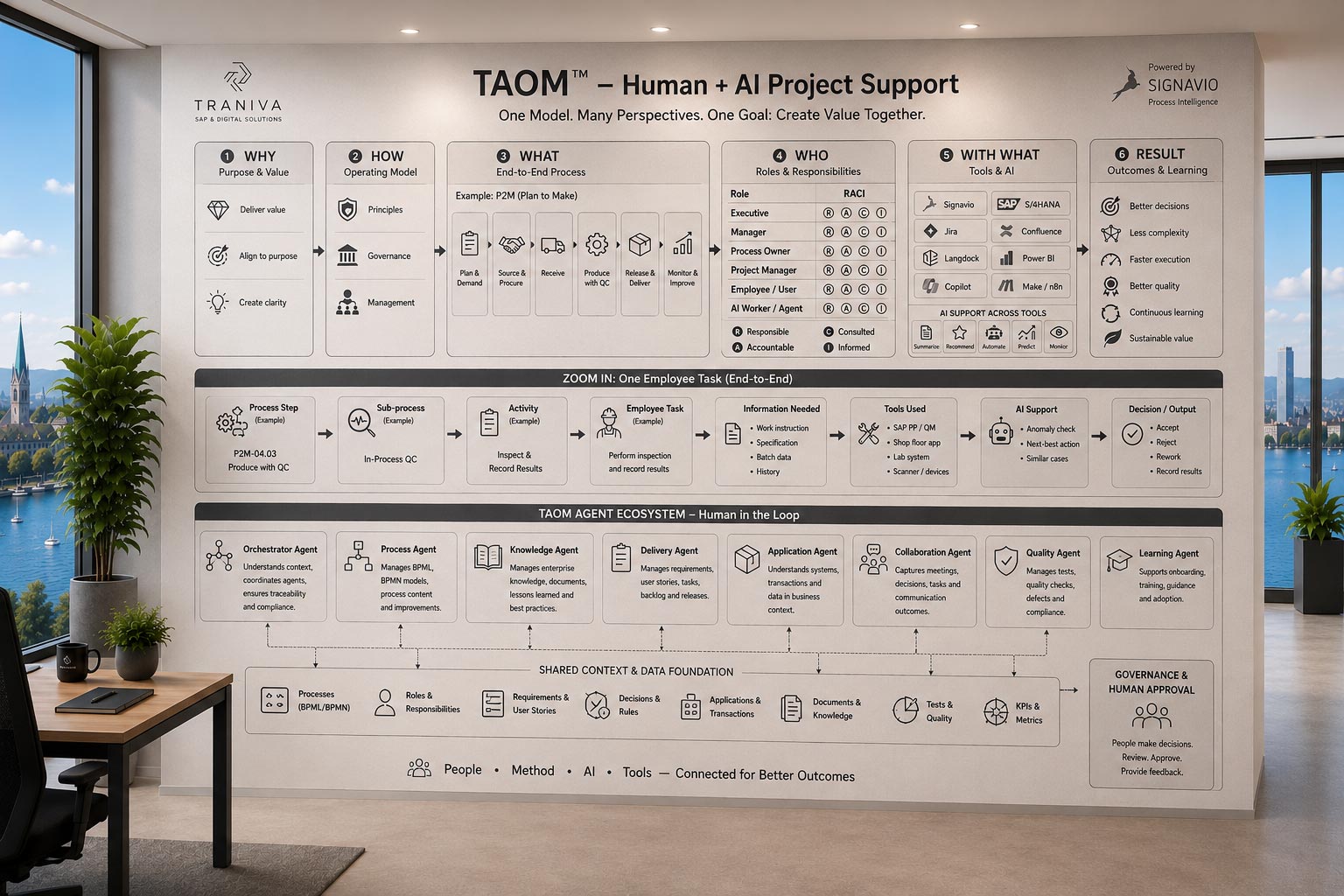
The Adaptive AI Organization Method™ from TranivaOrganisationen verfügen heute über zahlreiche Methoden, Systeme und Werkzeuge. Prozesse werden in Signavio modelliert, Anforderungen in Jira verwaltet, Wissen in Confluence dokumentiert, operative Arbeit in SAP ausgeführt und Kommunikation findet über Teams, Outlook und weitere Plattformen statt. Gleichzeitig steigt der Einsatz von Artificial Intelligence, Automatisierung und spezialisierten AI Agents.
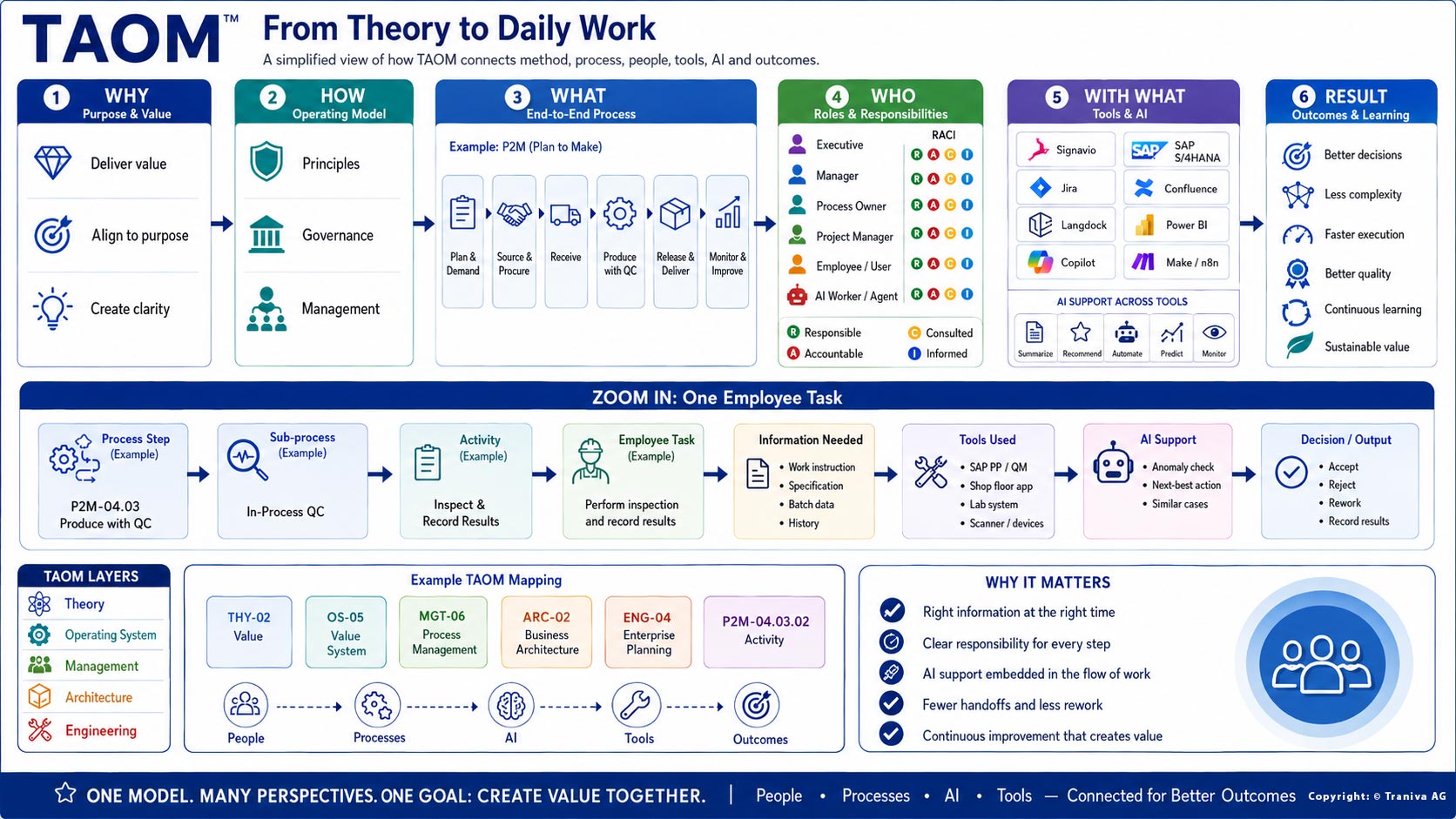
Companies do not create added value. People create added value. TAOM ensures that every individual is supported at the right moment with the right knowledge, the right tools, the right AI and the right guidance.
TAOM in a Project
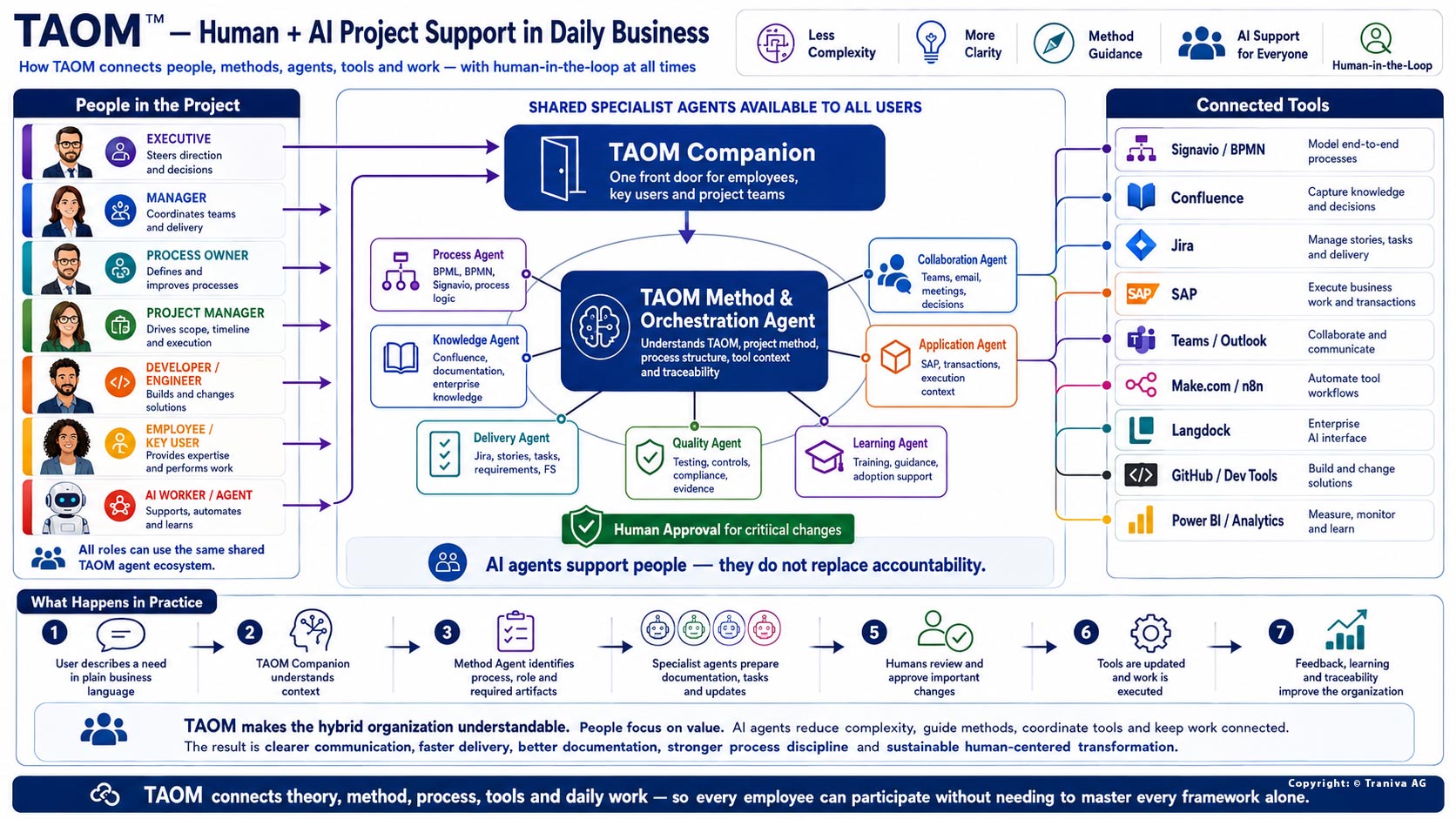
Human + AI Project Support in Daily BusinessTAOM wird besonders dort greifbar, wo klassische Projektstrukturen, Unternehmensprozesse und tägliche Arbeit aufeinandertreffen.
In a transformation project, management, project leaders, process owners, key users, developers, quality assurance staff and other roles work together, each with different tasks, methods and tools. At the same time, processes must be documented, requirements assessed, decisions recorded, developments managed, tests carried out and staff empowered.
For individual project staff, this quickly results in a working environment that is almost impossible to keep track of:
- Processes and roles in BPML and Signavio
- Requirements, epics, user stories and tasks in Jira
- Descriptions, decisions and specifications in Confluence
- Operational functions and transactions in SAP
- Meetings and communication in Teams and Outlook
- Automations in Make.com, n8n or Power Automate
- Analyses and KPIs in Power BI or SAP Analytics Cloud
TAOM does not reduce this complexity by replacing all the tools.
TAOM creates a common, methodological and AI-supported layer of support linking people, project methodology, processes, knowledge and tools.
All project roles use the same controlled agent ecosystem. AI supports people, but does not replace either responsibility or approval.
A single point of entry for all project participants
At the heart of it all is the TAOM Companion.
It serves as the single point of entry for staff, key users, project teams and managers. A user can describe a requirement in everyday language without first having to decide which tool or project method is appropriate.
An example from day-to-day project work
“In the process order, a check must be carried out before approval to ensure that all quality-relevant characteristics are present. The current procedure is unclear and must be documented, implemented and tested.”
The TAOM Companion identifies the project context, the user’s role, the process concerned and the desired outcome. The requirement is then passed on to the TAOM Method & Orchestration Agent.
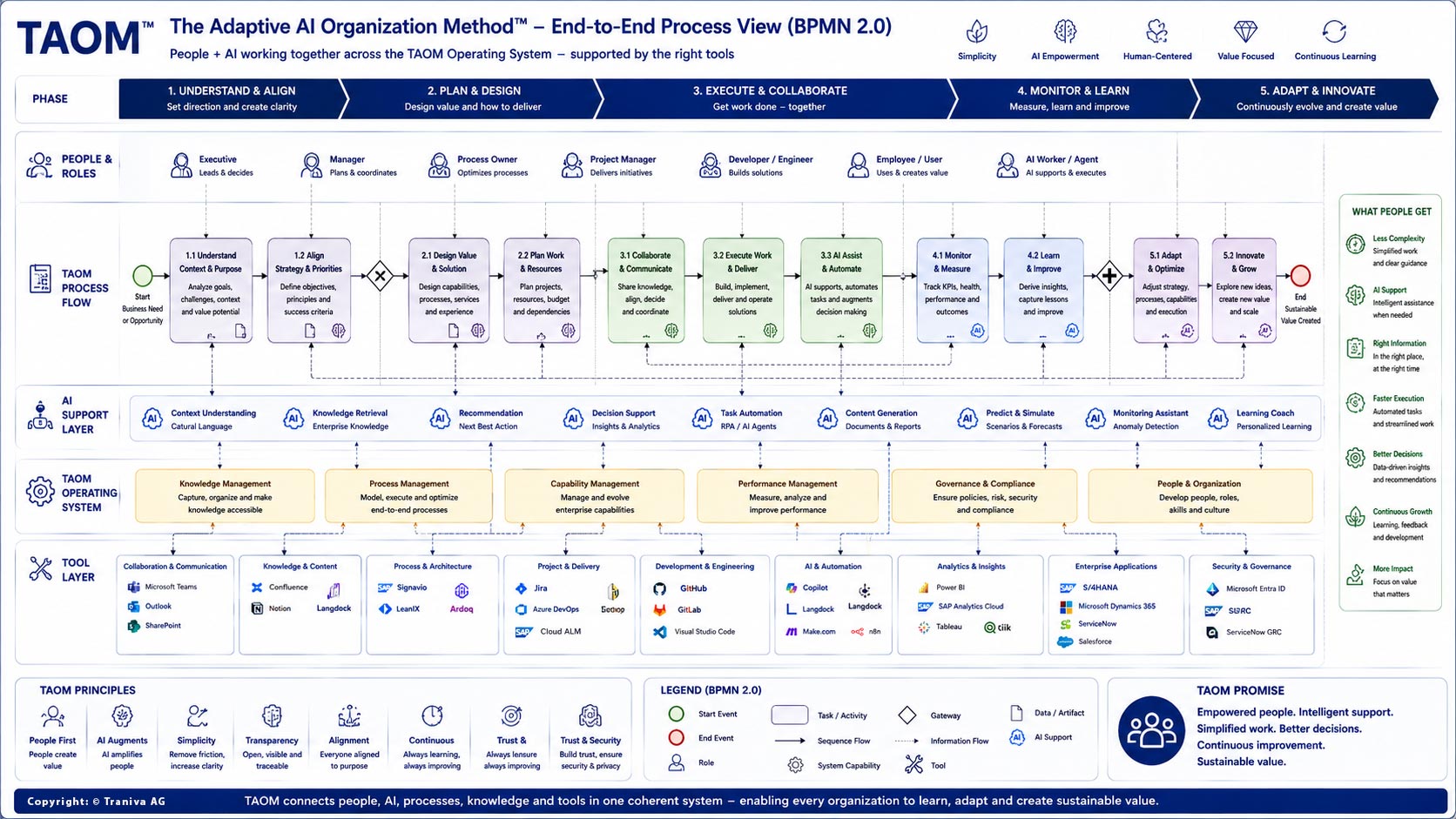
Der TAOM Method & Orchestration Agent
The Method & Orchestration Agent is the project’s methodological guardian.
He knows:
- the TAOM structure
- the project methodology used
- the end-to-end process hierarchy
- Roles and responsibilities
- the necessary project artefacts
- the associated tools
- Approvals and governance rules
- the relationships between process, requirement, implementation, testing and outcome
He does not replace either the project manager or the process owner.
His role is to ensure that project work remains complete, consistent, clear and transparent.
From business requirements to concrete project deliverablesVom fachlichen Bedarf zu konkreten Projektartefakten
Based on a technical requirement, the Method & Orchestration Agent may, for example, deduce:
- Any affected BPML and BPMN process steps must be adjusted.
- Existing Confluence content needs to be updated.
- A Jira user story with acceptance criteria is required.
- A functional specification must be drawn up.
- SAP transactions, roles or applications must be assigned.
- Test cases, risks and controls need to be added.
- A need for training or communication arises.
Specialist agents for the entire projectDie spezialisierten Agenten stehen nicht nur einem einzelnen Benutzer zur Verfügung. Sie sind gemeinsame digitale Projektrollen für alle berechtigten Projektbeteiligten.
Process Agent
Supports BPML, BPMN, Signavio, process hierarchies, roles, systems, transactions, inputs, outputs, risks, controls and KPIs.
Knowledge Agent
Finds and organises knowledge from Confluence, SharePoint, documentation, decisions, specifications and lessons learnt.
Delivery Agent
Translates business requirements into epics, user stories, tasks, functional specifications, test objects, dependencies and deliverables.
Agent Collaboration
Analyses Teams meetings, minutes and emails, and enters confirmed decisions, tasks, risks and outstanding issues into the relevant systems.
Application Agent
Establishes the business and technical context of the application, for example between a process step, SAP S/4HANA and a specific transaction such as COR1.
Quality Agent
Links requirements, risks, controls, tests, evidence, defects and approvals.
Learning Agent
Tailors explanations, instructions and learning content to the user’s role, expertise and specific work situation.
‘Human-in-the-loop’ remains mandatoryTAOM betrachtet AI als Unterstützung und nicht als Ersatz menschlicher Verantwortung.
AI may provide support
- Searching for and summarising information
- Explaining connections
- Prepare drafts
- Identifying missing artefacts
- Report inconsistencies and risks
- Recommend next steps
- Automating approved routines
People remain responsible
- Technical decisions
- Approval of process models
- Priority and scope
- Binding specifications
- Productive system changes
- Quality, compliance and safety approvals
- Organisational implications
Critical changes are therefore only implemented after they have been checked by a human.
How support works within the project
- A user describes their requirements in clear, business-like language.
- The TAOM Companion recognises role, context and objective.
- The Method & Orchestration Agent identifies processes, methods, artefacts and responsibilities.
- Specialist agents prepare documentation, tasks, models, tests and tool updates.
- Those in charge review and approve important changes.
- The linked tools are updated in a controlled manner and the work is carried out.
- Results, feedback, measurement data and lessons learnt are fed back into the project.
TAOM manages the complexity behind the scenes
This means that staff do not need to master all the methods, systems and documentation rules themselves.
They can see the relevant task, the correct information, the next step, the responsible role and the appropriate support.
TAOM manages the complexity behind the scenes.
Added value for client projectsDer Einsatz von TAOM kann insbesondere SAP-Transformationen, Prozessharmonisierungen und organisationsweite Veränderungsprogramme systematisch unterstützen.
- Clearer communication between management, the project team and the specialist department
- Faster translation of technical requirements into deliverables that can be implemented
- Full traceability from process to test
- Less duplication of data and less information lost
- Making better use of existing systems and platforms
- Higher quality and methodological consistency
- Faster induction for key users and project staff
- Continuous learning from project decisions and outcomes
- Controlled use of AI across all project roles
The actual benefit
TAOM does not introduce any additional complexity for the user.
The method takes complexity on board, structures it and simplifies it at the right moment.
People create value. AI enhances human capabilities. TAOM brings together theory, methodology, processes, knowledge, tools and day-to-day work.
This means that the hybrid organisation is not just an abstract vision of the future, but a working model that can be implemented step by step.
Next stepDas vollständige TAOM Framework wird als wachsendes, versioniertes Body of Knowledge veröffentlicht.
Framework: TAOM™ – The Adaptive AI Organization Method™
Version: 1.0.0-DRAFT
Status: Draft
Classification: Normative
Owner: Traniva AG
Language: English
Author: Traniva AG
Copyright: © Traniva AG