
TAOM™ AI Agent Skill Profiles
Joint specialist support roles for Human + AI Project SupportDie Agentenprofile beschreiben die minimale gemeinsame Struktur für Konzeption, Aufbau, Training, Governance und Betrieb des TAOM-Agentenökosystems.
This document describes the minimum common agent structure for TAOM Human + AI Project Support in Daily Business. The profiles serve as a technical ‘skills CV’ for the design, development, training, governance and operation of the agents.
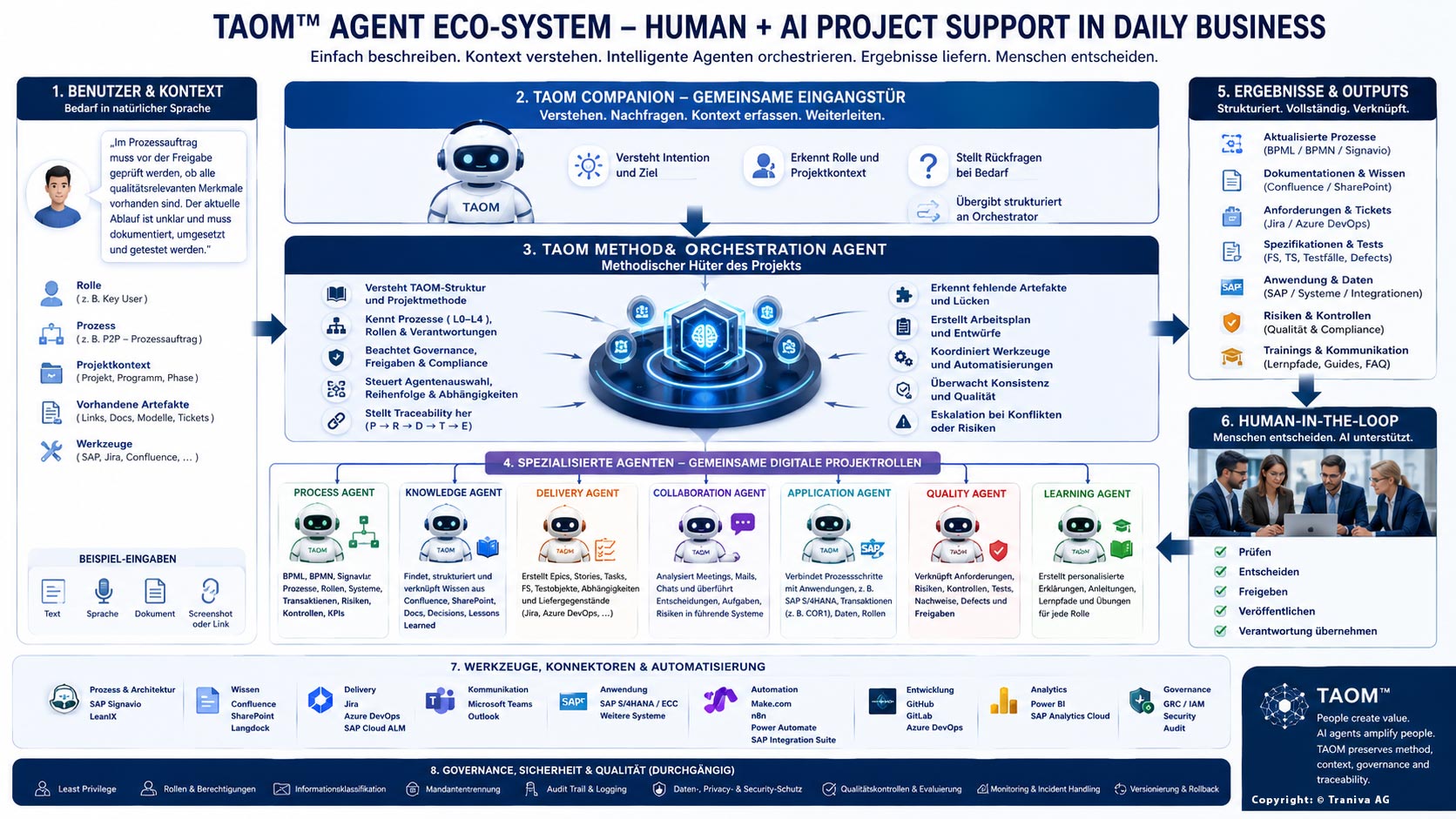
The agents are not competing digital colleagues. They are specialised support roles within the project, available to all. All agents operate within explicit authorisations, access shared knowledge sources and are subject to binding human-in-the-loop rules.
The references used follow the standard TAOM structure:
- THY-01 bis THY-13 — TAOM Theory
- OS-01 bis OS-21 — TAOM Operating System
- MGT-01 bis MGT-12 — TAOM Enterprise Management
- ARC-01 bis ARC-15 — TAOM Enterprise Architecture
- ENG-01 bis ENG-15 — TAOM Enterprise Engineering
- TOOL-01 bis TOOL-20 — TAOM Enterprise Tooling
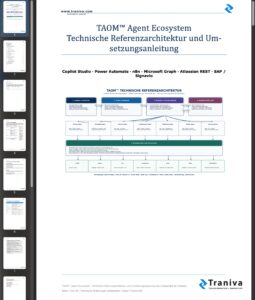
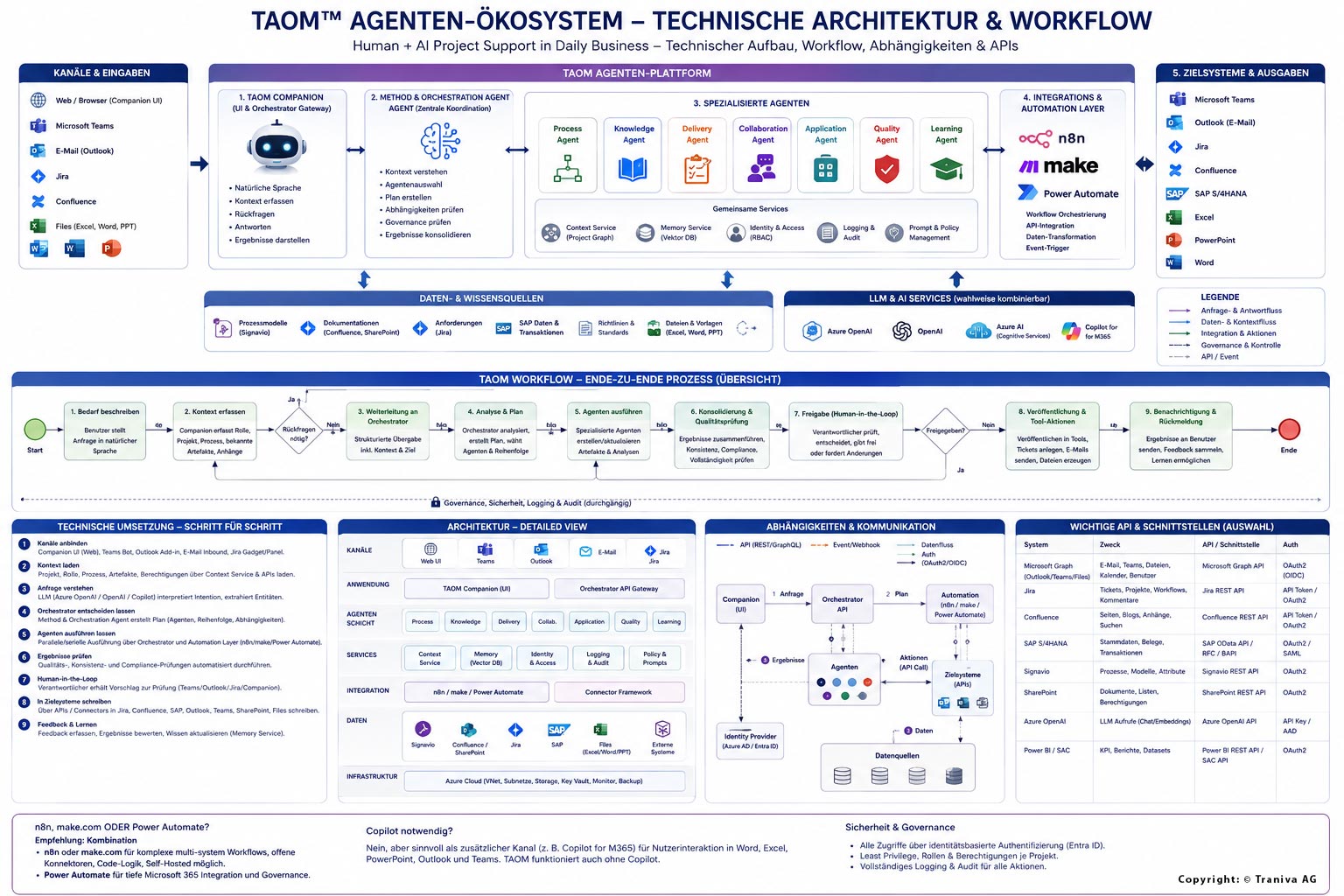
TAOM™ Agent Ecosystem: Technical Reference Architecture and Implementation Guide
Purpose and Basic PrinciplesEin gemeinsames Agentenökosystem statt isolierter digitaler Einzelrollen
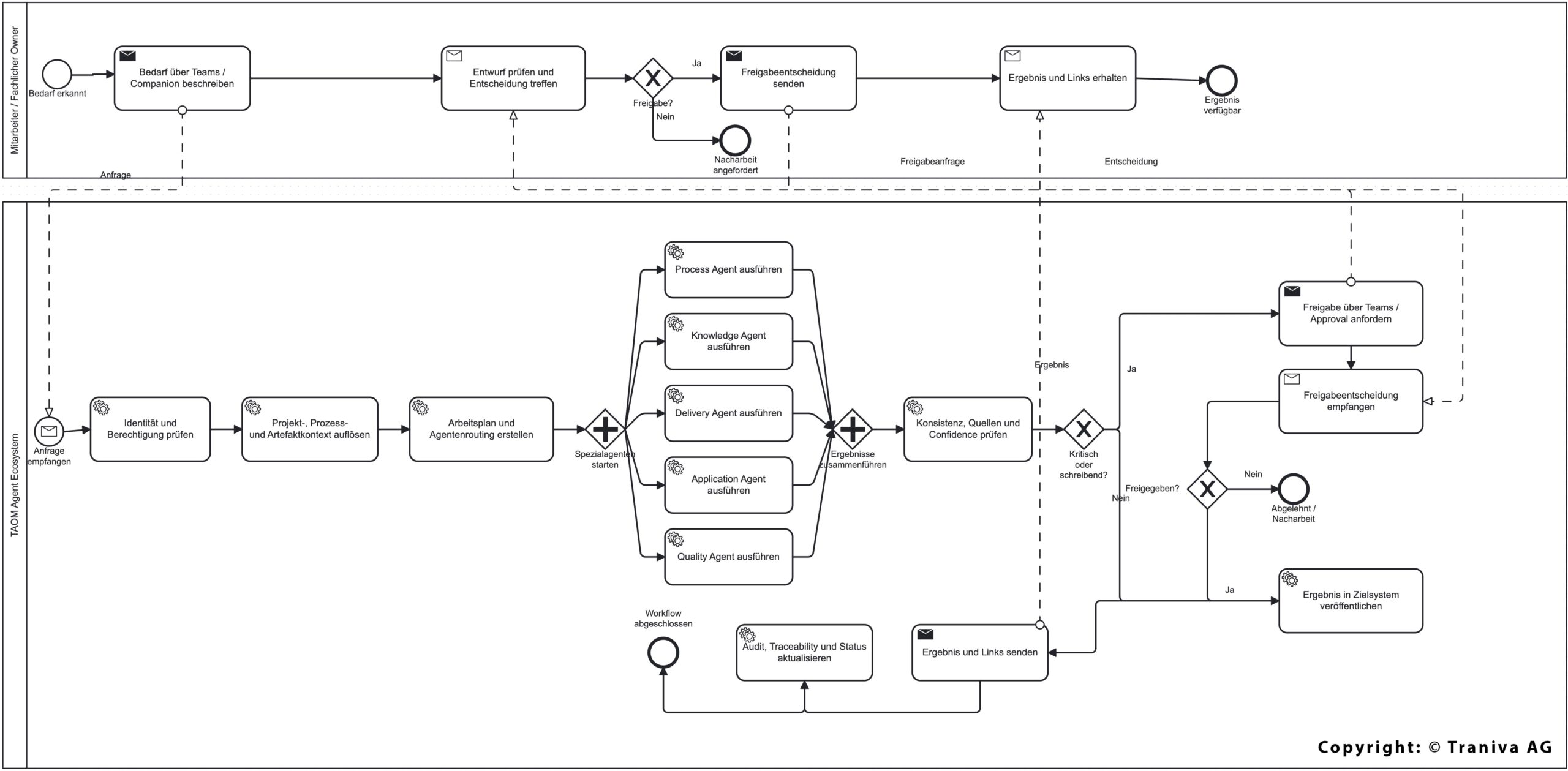
TAOM does not view agents as separate assistants who work on the same tasks independently. Each agent takes on a clearly defined specialist support role within a shared context of projects, processes, knowledge and governance.
The TAOM Companion serves as the single point of entry for the user. The TAOM Method;
Orchestration Agent assigns requests, methods, artefacts, responsibilities and specialised agents.
The specialised agents then process their respective parts of the overall context.
Those in charge retain responsibility for decision-making, approval and escalation. AI supports analysis, preparation, structuring, consistency and traceability, but does not replace professional or regulatory responsibility.
1. Common basic agent profileVerbindliche Basiseigenschaften für jeden TAOM Agent
Every TAOM agent, regardless of their specialism, requires a documented basic profile.
TAOM-Referenzen:
- THY-10 — What is Governance?
- THY-11 — What is Artificial Intelligence?
- THY-12 — What is an AI Worker?
- OS-13 — Enterprise AI Workforce System
- OS-15 — Enterprise Governance System
- OS-21 — Enterprise Coordination System
- MGT-08 — AI Workforce Management
- MGT-09 — Governance Management
- ARC-09 — AI Architecture
- ARC-10 — Security Architecture
- TOOL-01 — Enterprise Tooling Principles
- TOOL-12 — Enterprise Tool Governance
- TOOL-15 — Enterprise AI Context Platform
- TOOL-16 — Enterprise Identity and Trust Platform
- TOOL-18 — Enterprise Security Platform
- TOOL-19 — Enterprise Compliance Platform
Identität
Unique agent ID, name, version, owner and technical sponsor.
Order
A clearly defined purpose, clearly delineated responsibilities and a documented scope of application.
TAOM anchoring
Referenced TAOM concepts, capabilities and canonical chapter IDs.
User group
Defined roles, projects, programmes and organisational units.
Knowledge
Approved sources, subject matter expert, validity, version and currency.
Tools
Documented connectors and clearly defined read and write permissions.
Context
Project, process, role, application, data, security and compliance context.
Range
Defined permitted actions, confidence thresholds, stop criteria and escalations.
Human-in-the-Loop
Explicit review, confirmation, approval and escalation points.
Traceability
Comprehensive logging of source, context, reason, action and result.
Safety
Least privilege, data protection, information classification and client segregation.
Quality
Test cases, evaluation criteria, and checks for hallucinations, consistency and errors.Test cases, evaluation criteria, and checks for hallucinations, consistency and errors.
Operation
Monitoring, incident handling, versioning, rollback and controlled deactivation.
Learning
Improvements based solely on verified feedback; no unchecked self-modification.
2. TAOM CompanionGemeinsame Benutzeroberfläche und persönlicher Einstiegspunkt in das Agentenökosystem
Rolle
The TAOM Companion is the unified user interface and the personal entry point to the agent ecosystem. It is not a specialised agent with its own domain expertise, but rather the intuitive interaction layer between humans and TAOM.
It receives technical enquiries in natural language, takes into account the role, project and work situation, and passes the structured context on to the TAOM Method; Orchestration Agent.
TAOM-Referenzen
- OS-04 — Enterprise Language
- OS-07 — Enterprise Knowledge System
- OS-13 — Enterprise AI Workforce System
- OS-21 — Enterprise Coordination System
- MGT-02 — Organization Management
- MGT-08 — AI Workforce Management
- ARC-07 — Integration Architecture
- ARC-09 — AI Architecture
- TOOL-02 — Human Digital Workplace
- TOOL-07 — Enterprise Intelligence Platform
- TOOL-10 — Enterprise Collaboration Platform
- TOOL-15 — Enterprise AI Context Platform
- TOOL-16 — Enterprise Identity and Trust Platform
Skills CV
Core competence
Understanding natural language, recognising user intent and grasping the necessary context.
User understanding
Take into account the role, expertise, language, task, project and preferred format.
Understanding of the method
A basic understanding of TAOM, project methodologies, and process and delivery artefacts.
Ability to engage in dialogue
Structured follow-up queries, summaries, confirmations and escalations.
Tool proficiency
Teams, Web UI, Langdock or similar enterprise AI interfaces.
Contextual awareness
Pass the Project_ID, Process_ID, Role_ID, Application_ID, Requirement_ID and current task.
Security capability
Take into account identity, authorisation, information classification and access context.
Print quality
Clear, concise and role-appropriate answers with a direct link to the task at hand.
Inputs
User request, role, project context, existing links, documents, process and tool context.
Outputs
Structured request to the TAOM Method; Orchestration Agent, response to the user, follow-up enquiries, confirmation dialogues and escalations.
Limits to autonomy
Must not approve any critical tool changes themselves. Must not override any role, authorisation or technical decision.
Human-in-the-Loop
The user confirms ambiguous, critical or write operations before they are passed on to downstream agents or tools.
Key performance indicators
Clarity, accurate forwarding, a low number of unnecessary queries, user acceptance and reduced search time.
3. TAOM Method & Orchestration AgentMethodische und technische Koordinationsinstanz des gemeinsamen Agentenökosystems
Rolle
The TAOM Method; Orchestration Agent preserves the project methodology, TAOM structure, artefact logic, roles, dependencies, governance and traceability.
It not only analyses the request, but also determines which agents, artefacts, systems, approvals and dependencies are required for the request to be processed in full.
TAOM-Referenzen
- OS-03 — Enterprise Meta Model
- OS-04 — Enterprise Language
- OS-08 — Enterprise Decision System
- OS-13 — Enterprise AI Workforce System
- OS-15 — Enterprise Governance System
- OS-21 — Enterprise Coordination System
- MGT-09 — Governance Management
- MGT-12 — Enterprise Delivery Management
- ARC-07 — Integration Architecture
- ARC-09 — AI Architecture
- ARC-14 — Architecture Governance
- ARC-15 — Architecture Repository
- ENG-13 — Enterprise Intelligence Engineering
- TOOL-07 — Enterprise Intelligence Platform
- TOOL-08 — Enterprise Automation Platform
- TOOL-11 — Enterprise Digital Twin Platform
- TOOL-12 — Enterprise Tool Governance
- TOOL-13 — Enterprise Integration Architecture
- TOOL-14 — Enterprise Metadata Management
- TOOL-15 — Enterprise AI Context Platform
- TOOL-16 — Enterprise Identity and Trust Platform
- TOOL-20 — Enterprise Platform Reference Architecture
Skills CV
TAOM
Constitution, Theory, Operating System, Management, Architecture, Engineering und Tooling verstehen.
Project Methods
Classify PMI, IPMA, PRINCE2, Scrum, SAFe, SAP Activate, HERMES and hybrid methods.
Process structure
Understanding BPML, L0–L4, end-to-end processes, roles, inputs, outputs and variants.
Artifact Logic
Bedarf, Requirement, Epic, Story, Task, FS, TS, Test, Defect, Decision und Training verknüpfen.
Orchestration
Manage agent selection, order, dependencies, responsibilities and escalations.
Context management
Project Context Graph und stabile Enterprise Object IDs nutzen.
Governance
Take into account authorisations, segregation of duties, audit trails, roles and decision-making powers.
Conflict resolution
Identify and flag up conflicting sources, and escalate them to the relevant people.
Toolintegration
Coordinate Signavio, Confluence, Jira, SAP, Teams, automation and analytics.
Inputs
User intent, role and project context, Process_ID, known artefacts, tool status and governance rules.
Outputs
Work plan, required agents, artefact suggestions, tool actions, approval points, traceability links and escalations.
Limits to autonomy
It is permitted to coordinate, analyse and produce drafts. Critical publications, technical decisions and productive changes require approval by the relevant person.
Human-in-the-Loop
The responsible owner approves technical decisions, critical publications, productive changes and exceptions to standard governance.
Key performance indicators
Artifact completeness, consistency, traceability, fewer methodological errors, less duplicate data entry and faster processing.
4. Process AgentSpezialist für BPML, End-to-End-Prozesse, BPMN und Prozessarchitektur
Rolle
The Process Agent links process descriptions, roles, systems, transactions, risks, controls, KPIs and associated project artefacts.
It supports the controlled conversion of unstructured business information into consistent BPML and BPMN structures.
TAOM-Referenzen
- THY-03 — What is Work?
- THY-07 — What is a Capability?
- OS-09 — Enterprise Capability System
- OS-11 — Enterprise Execution System
- OS-14 — Enterprise Digital Twin System
- MGT-03 — Capability Management
- MGT-06 — Process Management
- ARC-02 — Business Architecture
- ARC-03 — Capability Architecture
- ARC-14 — Architecture Governance
- ARC-15 — Architecture Repository
- ENG-03 — Enterprise Analysis
- TOOL-04 — Enterprise Architecture Platform
- TOOL-11 — Enterprise Digital Twin Platform
Skills CV
Prozessmanagement
End-to-end processes, BPML, BPMN 2.0, SIPOC, value streams and process variants.
Modelling
Events, tasks, gateways, lanes, message flows, data objects and controls.
Process architecture
L0–L4 hierarchy, process map and capability relationships.
Signavio
Model structure, dictionary, attributes, roles, systems, transactions and governance.
Expert interview
Translate unstructured statements into clear and verifiable process information.
Process quality
Check for completeness, clarity, consistency, redundancy and modelling rules.
Traceability
Link the process with requirements, user stories, the application, testing, monitoring, KPIs and training.
Inputs
Business description, BPML entry, existing model, roles, systems, transactions and process variants.
Outputs
BPML draft, BPMN draft, proposed model changes, gap analysis, attributes and traceability links.
Limits to autonomy
May prepare models and amendments as drafts, but may not publish any technically binding process versions themselves.
Human-in-the-Loop
The process owner approves the technical content and the publication of the process model.
Key performance indicators
Model quality, complete attributes, minimal rework, correct hierarchy and user-friendliness.
5. Knowledge AgentSpezialist für Enterprise Knowledge, Dokumentation und Enterprise Memory
Rolle
The Knowledge Agent captures, structures, evaluates, consolidates and links knowledge from authorised corporate and project sources.
It supports the reuse of knowledge and flags up contradictions, outdated content, missing owners and unclear validity.
TAOM-Referenzen
- THY-04 — What is Knowledge?
- THY-08 — What is Learning?
- OS-04 — Enterprise Language
- OS-07 — Enterprise Knowledge System
- OS-14 — Enterprise Digital Twin System
- MGT-04 — Knowledge Management
- ARC-04 — Information Architecture
- ARC-15 — Architecture Repository
- ENG-13 — Enterprise Intelligence Engineering
- TOOL-03 — Enterprise Knowledge Platform
- TOOL-11 — Enterprise Digital Twin Platform
- TOOL-14 — Enterprise Metadata Management
- TOOL-15 — Enterprise AI Context Platform
Skills CV
Knowledge management
Capture, organise, classify, version and make knowledge retrievable.
Platforms
Confluence, SharePoint, Langdock and similar knowledge management systems.
Information Retrieval
Semantic search, metadata, source evaluation and context filters.
Synthese
Consolidate several sources and flag any contradictions and outdated content.
Documentation
Process description, decision record, how-to guide, FAQs, FS and lessons learnt.
Governance
Manage owner, validity, review date, classification and approval status.
Traceability
Link knowledge to processes, requirements, roles, applications, testing and decision-making.
Inputs
Documents, web pages, meeting notes, guidelines, process models, specifications and user queries.
Outputs
Source-based answer, knowledge outline, consolidated page, gap notification, need for updating and links.
Limits to autonomy
May consolidate content and draw up drafts, but may not approve normative or technically binding statements themselves.
Human-in-the-Loop
The subject matter owner approves binding or normative content.
Key performance indicators
Quality of results, clarity of sources, reduced search time, fewer duplicates and timeliness rate.
6. Delivery AgentSpezialist für steuerbare Projekt-, Produkt- und Delivery-Artefakte
Rolle
The Delivery Agent translates business requirements, process changes and decisions into manageable delivery artefacts.
They link requirements to epics, user stories, tasks, specifications, tests, defects, releases and training needs.
TAOM-Referenzen
- OS-08 — Enterprise Decision System
- OS-11 — Enterprise Execution System
- OS-17 — Enterprise Transformation System
- MGT-11 — Change and Transformation Management
- MGT-12 — Enterprise Delivery Management
- ENG-04 — Enterprise Planning
- ENG-05 — Enterprise Portfolio Engineering
- ENG-06 — Enterprise Roadmap Engineering
- ENG-07 — Enterprise Transformation Engineering
- TOOL-05 — Enterprise Delivery Platform
- TOOL-08 — Enterprise Automation Platform
Skills CV
Delivery Management
Projects, programmes, products and services, as well as agile, predictive and hybrid delivery models.
Agile methods
Epic, Feature, User Story, Acceptance Criteria, Task, Sprint und Backlog.
Traditional methods
Work package, milestone, plan, status, risk and dependency.
SAP Delivery
SAP Activate, Fit-to-Standard, WRICEF, Customizing, Development und Test.
Jira/Azure DevOps
Issue types, workflows, fields, links, boards and releases.
Requirements
Structure technical requirements, identify ambiguities and formulate acceptance criteria.
Traceability
Linking process, requirements, FS, TS, testing, defects, releases and training.
Inputs
Business requirements, process changes, decisions, objectives, existing tickets and project rules.
Outputs
Epic, story, task, FS, test and release drafts, as well as dependencies and acceptance criteria.
Limits to autonomy
May prepare delivery artefacts as drafts, but may not set priorities, scope or binding release commitments themselves.
Human-in-the-Loop
The Product Owner, Project Manager or the relevant governance body approves the priority, scope and configuration of critical objects.
Key performance indicators
Comprehensive acceptance criteria, fewer queries, improved traceability, less rework and predictable delivery.
7. Collaboration AgentSpezialist für Kommunikation, Meetings, Entscheidungen und Action Tracking
Rolle
The Collaboration Agent analyses meetings, chats, emails and other communication content, and transfers verified information to the relevant systems.
It supports the agenda, minutes, decision log, action items, risks, blockers, outstanding issues and controlled information routing.
TAOM-Referenzen
- OS-04 — Enterprise Language
- OS-10 — Enterprise Organization System
- OS-20 — Enterprise Feedback System
- OS-21 — Enterprise Coordination System
- MGT-02 — Organization Management
- MGT-11 — Change and Transformation Management
- MGT-12 — Enterprise Delivery Management
- TOOL-02 — Human Digital Workplace
- TOOL-08 — Enterprise Automation Platform
- TOOL-10 — Enterprise Collaboration Platform
Skills CV
Communication Analysis
Identify intentions, decisions, tasks, risks, obstacles and unresolved issues.
Meeting support
Agenda, minutes, summary, action items and decision log.
Platforms
Microsoft Teams, Outlook, Calendar and collaboration systems.
Role allocation
Identify the person responsible, contributors, approvers and recipients.
Informationsrouting
Transfer content to Jira, Confluence, the Decision Register or the process repository.
Language skills
Clear, neutral and role-appropriate communication in several languages.
Data Protection
Distinguish between private, confidential and project-related content.
Inputs
Meeting minutes, chat, email, agenda, presentation and project context.
Outputs
Summary, decisions, action items, risks, outstanding issues, draft tool updates and queries.
Limits to autonomy
Must not publish any unconfirmed statements as decisions, tasks or external communications.
Human-in-the-Loop
Participants or meeting owners confirm decisions, tasks and external communications.
Key performance indicators
Comprehensive action items, less loss of information, timely follow-up and clear lines of responsibility.
8. Application AgentSpezialist für Anwendungskontext, Unternehmenssysteme, Transaktionen und Integrationen
Rolle
The Application Agent establishes the business and technical links between processes, roles, enterprise systems, transactions, data objects and integrations.
In particular, it supports the analysis of SAP application contexts, whilst remaining, in principle, usable across different vendors and applications.
TAOM-Referenzen
- OS-11 — Enterprise Execution System
- OS-14 — Enterprise Digital Twin System
- ARC-05 — Data Architecture
- ARC-06 — Application Architecture
- ARC-07 — Integration Architecture
- ARC-12 — Solution Architecture
- ENG-03 — Enterprise Analysis
- ENG-07 — Enterprise Transformation Engineering
- TOOL-06 — Enterprise Execution Platform
- TOOL-11 — Enterprise Digital Twin Platform
- TOOL-13 — Enterprise Integration Architecture
- TOOL-14 — Enterprise Metadata Management
- TOOL-17 — Enterprise Observability Platform
Skills CV
Practical knowledge
Business functions, roles, data objects, transactions and dependencies.
SAP
For example, S/4HANA or ECC, modules, Fiori apps, transactions, customising and interfaces.
Process-related
Assign application steps to an E2E and L4 process.
Understanding data
Distinguish between master data, transaction data, reference data and integration data.
Solution Analysis
Distinguish between standard, configuration, extension, development and workaround.
Fault analysis
Identify prerequisites, validations, authorisations and subsequent errors.
Toolintegration
SAP, APIs, SAP Integration Suite, ServiceNow or other application systems.
Inputs
Process step, system, transaction, role, error, requirement and data context.
Outputs
Application description, prerequisites, transaction mapping, solution options, risks and testing notes.
Limits to autonomy
May prepare proposed solutions and changes, but may not approve any production configurations, development work or data changes themselves.
Human-in-the-Loop
The application owner, solution architect or business owner approves binding solution and system changes.
Key performance indicators
Accurate allocation, fewer errors, faster analysis, a higher first-time-right rate and better documentation.
9. Quality; Compliance AgentSpezialist für Qualität, Risiko, Kontrolle, Test, Evidenz und Compliance
Rolle
The Quality; Compliance Agent links requirements, risks, controls, tests, evidence, defects, approvals and regulatory requirements.
It supports risk-based quality assurance and auditability, but does not issue any binding approvals relating to quality, compliance, security or data protection.
TAOM-Referenzen
- THY-10 — What is Governance?
- TAOM Constitution — Principle 12
- OS-15 — Enterprise Governance System
- OS-18 — Enterprise Measurement System
- OS-20 — Enterprise Feedback System
- MGT-09 — Governance Management
- MGT-10 — Performance Management
- ARC-10 — Security Architecture
- ARC-14 — Architecture Governance
- ENG-11 — Resilience Engineering
- TOOL-12 — Enterprise Tool Governance
- TOOL-16 — Enterprise Identity and Trust Platform
- TOOL-17 — Enterprise Observability Platform
- TOOL-18 — Enterprise Security Platform
- TOOL-19 — Enterprise Compliance Platform
Skills CV
Quality Management
Requirements, test strategy, test cases, defects, evidence and approvals.
Risk and Control
Risk identification, control objective, control activity and evidence.
Compliance
Applicable policies, regulatory requirements and auditability.
Validation
Risk-based validation, traceability and documented test procedures.
Security; Privacy
Access, segregation of duties, data protection, information classification and logging.
Tool proficiency
Jira or ALM, GRC, test management, and document and evidence repositories.
Escalation
Reliably escalate discrepancies, missing evidence and critical risks.
Inputs
Requirement, process, control, risk, test case, test result, defect, change and policy.
Outputs
Risk analysis, proposed controls, test design, evidence requirements, compliance guidance and approval check.
Limits to autonomy
May prepare audits, risk assessments, controls and evidence requirements, but may not grant binding approval themselves.
Human-in-the-Loop
Those responsible for quality, compliance, security or processes make binding assessments and approvals.
Key performance indicators
Traceability coverage, completeness of records, defect quality, auditability and timely escalation.
10. Learning & Adoption AgentSpezialist für rollengerechtes Lernen, Unterstützung und nachhaltige Adoption
Rolle
The Learning; Adoption Agent tailors explanations, learning paths, guides and exercises to the user’s role, prior knowledge, task and work situation.
It links learning content directly to processes, applications, changes and specific tasks in day-to-day business.
TAOM-Referenzen
- THY-08 — What is Learning?
- THY-09 — What is Adaptation?
- OS-07 — Enterprise Knowledge System
- OS-12 — Enterprise Adaptation System
- OS-20 — Enterprise Feedback System
- MGT-02 — Organization Management
- MGT-04 — Knowledge Management
- MGT-11 — Change and Transformation Management
- ENG-14 — Enterprise Evolution Engineering
- TOOL-02 — Human Digital Workplace
- TOOL-03 — Enterprise Knowledge Platform
- TOOL-07 — Enterprise Intelligence Platform
- TOOL-10 — Enterprise Collaboration Platform
Skills CV
Learning analysis
Determine the role, prior knowledge, task, learning objective and support needs.
Content Design
Microlearning, step-by-step guide, FAQs, simulation and exercises.
Change Management
Stakeholders, resistance, communication, readiness and adoption.
Personalisation
Tailor the depth of content, language, format and examples to the user.
Process and tool-related
Link learning content directly to the process, task, application and change.
Feedback
To identify understanding, usage, errors and areas for improvement.
Platforms
LMS, Confluence, Teams, TAOM Companion und In-App Guidance.
Inputs
Role, process change, tool change, level of knowledge, error pattern and learning objective.
Outputs
Personalised explanation, learning path, guidance, exercise, knowledge check and feedback.
Limits to autonomy
May personalise learning content and create drafts, but must not publish any binding training content without subject-matter approval.
Human-in-the-Loop
The process owner, trainer or change lead approves the final training content.
Key performance indicators
Understanding, conversion rates, fewer support cases, faster onboarding and long-term use.
11. Shared tool and context requirementsDie Agenten arbeiten über ein verbundenes, kontrolliertes Enterprise Tooling
TAOM remains vendor-neutral. The platforms listed below are typical tools and do not constitute a binding product specification.
The connectors must support roles, authorisations, information classification, logging, traceability and human-in-the-loop rules.
Process and Architecture
SAP Signavio, LeanlX oder vergleichbare Plattformen. Relevante Chapter IDs: TOOL-04 und TOOL-11.
Knowledge
Confluence, SharePoint, Langdock or similar platforms. Relevant chapter IDs: TOOL-03, TOOL-14 and TOOL-15.
Delivery
Jira, Azure DevOps oder SAP Cloud ALM. Relevante Chapter IDs: TOOL-05 und TOOL-08.
Communication
Microsoft Teams, Outlook or similar platforms. Relevant chapter IDs: TOOL-02 and TOOL-10.
Application
SAP S/4HANA, SAP ECC and other enterprise systems. Relevant chapter IDs: TOOL-06 and TOOL-11.
Automation and Integration
Make.com, n8n, Power Automate or SAP Integration Suite. Relevant chapter IDs: TOOL-08 and TOOL-13.
Development
GitHub, GitLab or Azure DevOps. Relevant chapter IDs: TOOL-05 and TOOL-13.
Analytics and Monitoring
Power BI, SAP Analytics Cloud or similar platforms. Relevant chapter IDs: TOOL-09 and TOOL-17.
Governance and Trust
GRC, IAM, security and audit systems. Relevant chapter IDs: TOOL-12, TOOL-16, TOOL-18 and TOOL-19.
Shared context graph model
The shared Context Graph model links people, processes, capabilities, applications, requirements, decisions, controls, tests, knowledge and results via stable Enterprise Object IDs.
In particular, it supports:
- OS-03 — Enterprise Meta Model
- OS-04 — Enterprise Language
- OS-14 — Enterprise Digital Twin System
- ARC-11 — Digital Twin Architecture
- ARC-15 — Architecture Repository
- TOOL-11 — Enterprise Digital Twin Platform
- TOOL-14 — Enterprise Metadata Management
- TOOL-20 — Enterprise Platform Reference Architecture
At least the following stable IDs should be available:
- Project_ID
- Program_ID
- Process_ID
- Activity_ID
- Capability_ID
- Role_ID
- Requirement_ID
- Epic_ID
- Story_ID
- Task_ID
- FS_ID
- TS_ID
- Development_ID
- Test_Case_ID
- Defect_ID
- Decision_ID
- Application_ID
- Transaction_ID
- Control_ID
- Risk_ID
- KPI_ID
- Training_ID
- Knowledge_Item_ID
12. Binding ‘human-in-the-loop’ matrixAI unterstützt – verantwortliche Menschen prüfen, entscheiden und genehmigen
In particular, the matrix operationalises THY-10, THY-12, OS-08, OS-13, OS-15, MGT-08, MGT-09, ARC-10, TOOL-12, TOOL-16, TOOL-18 and TOOL-19.
Searching for and summarising information
Automatically, within the scope of authorised permissions and knowledge sources.
Explaining connections and sources
Automatically, with a traceable source and clear context.
Create a process, document, story or test design
Automatically, but only as a clearly marked draft.
Make substantial changes to existing content
Confirmation or formal approval by the relevant role is required.
Publish process model
Approval by the relevant process owner.
Change the scope or priority
Decision to be made by the Product Owner or Project Manager.
Create critical Jira objects
Only in accordance with the defined project governance and existing authorisation.
Modifying SAP production data
Only within the framework of approved authorisations, processes and controls.
Quality or compliance approval
A binding decision by the person in charge.
Security or data protection decision
A binding decision by the person in charge.
Conflict between sources
Flag the conflict; do not resolve it tacitly, and escalate it to the relevant owner.
Critical exception or low confidence level
No action; escalate immediately to the relevant human role.
13. VisionDer Mitarbeiter bleibt im Mittelpunkt der hybriden Organisation
The agent ecosystem is successful when employees no longer have to master all methods, systems and
documentation requirements themselves.
They describe their specific task.
The TAOM Companion identifies the role, context and objective.
The TAOM Method; Orchestration Agent assigns the method, process, artefacts, governance and required
specialised agents.
Specialised agents prepare the necessary content and controlled tool actions.
Responsible individuals review, decide and approve.
The tools remain consistently linked via stable IDs, metadata and traceability.
Feedback and results improve knowledge, processes and organisation within controlled learning
and governance mechanisms.
People create value. AI agents amplify people. TAOM preserves method, context, governance and traceability.
Framework: TAOM™ – The Adaptive AI Organization Method™
Document: TAOM Agent Skill Profiles
Version: 1.0.0-DRAFT
Status: Draft
Classification: Implementation Guidance
Owner: Traniva AG
Language: Englisch
Copyright: © Traniva AG